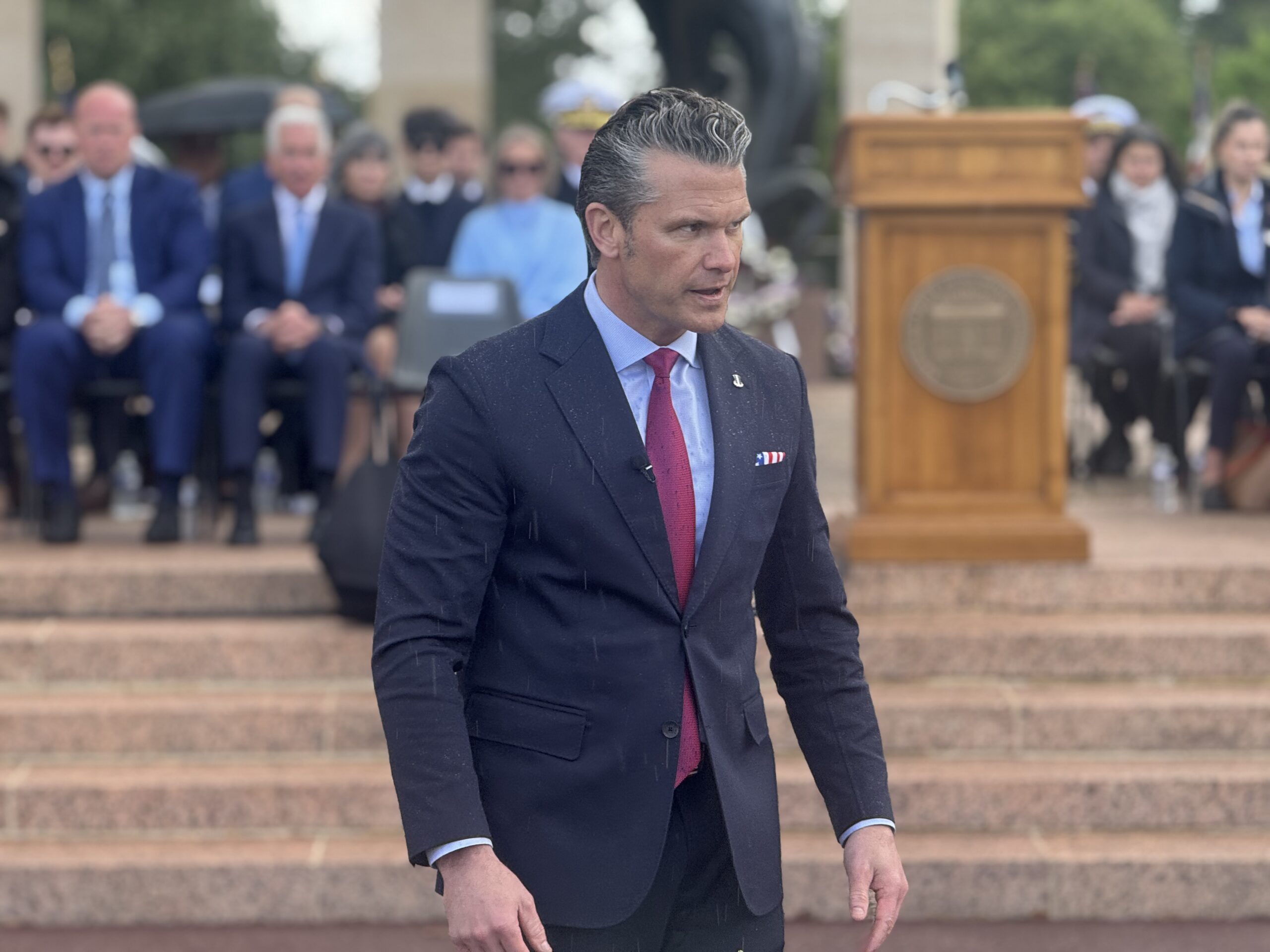
NORMANDY, France — U.S. Secretary of War Pete Hegseth warned about the invasion of Europe by third-world migrants in a Saturday speech commemorating the 82nd anniversary of D-Day. Hegseth spoke at the Normandy American Cemetery, where thousands of Americans are buried. All but one died storming the beaches on D-Day or in the subsequent Battle of Normandy during World War II.
“Sadly, today, different European beaches are stormed by different dangerous ideologies. Beaches in Spain and Italy and Greece and Bulgaria,” Hegseth said. “Boats and men arrive. When will European capitals do something about that invasion? Or is it too late? I pray not, and I believe not.”
Twenty-nine WWII veterans attended the ceremony, and 107-year-old Arthur Rose, a lieutenant in the U.S. Navy on D-Day, read a letter he sent home days after the invasion. French and American flags whipped on their poles as wind blasted through the cemetery and waves of rain and sunshine alternated, giving Hegseth an appropriate backdrop to offer a stark warning to Europe: They face yet another existential crisis today, this time from third-world migrants intent on destroying the West.
“They’ve opened their borders in many cases, defunded their militaries, and opened their welfare state, and you’ve got a flood of refugees that a lot of countries have had challenges dealing with,” Hegseth said in response to a reporter’s question after his speech. “Everybody knows that problem is one that Europe needs to confront, and we hope they do.”
The speech was not just a commemoration of the June 6, 1944, invasion that turned the tide of the war and began the liberation of France from Nazi occupation, but a modern call-to-arms for all European countries to remember their rich traditions of national pride, Christian heritage, military prowess, and cultural superiority.
“Our world is safer and more prosperous when the United States of America and our allies are strong, free, and unapologetic in defense of our Western tradition of freedom,” Hegseth said.
“The men who fought and died here restored freedom to Europe. That freedom must be maintained by this generation of leaders and war fighters, or what they fought for was merely temporary,” Hegseth said. “As our great President Ronald Reagan once said, freedom is never more than one generation away from extinction. You don’t pass it to the next generation in the bloodstream. It must be defended by each and every generation.”
Hegseth persistently pushed the need for a militarily prepared Europe, signaling that America should not be solely responsible for the defense of the continent.
“The men buried here fought in a war fighting alliance where every partner brought its full measure of industry, courage, and sacrifice — not empty slogans, not lavish summits, not communiques: Real allies doing real things, taking real losses for a shared cause worth fighting and dying for,” he said. “Each nation pulled its weight. Each nation bled. America will lead, and we must. But capable allies must be right there with us, shoulder to shoulder in the breach when it matters.”
He said that many countries in Europe “grew comfortable” after World War II and “forgot that peace is not wished into being. It is bought with purpose, with honor, and with strength.”
On the trip Hegseth also met with 200 Army soldiers, many paratroopers, in the town of Sainte-Mère-Église. There on June 5, 1944, paratroopers of the 82nd Airborne landed behind enemy lines to charge toward the beaches and meet those storming it the next day.
French, Dutch, and German troops training with U.S. troops attended that speech. Hegseth reiterated his call-to-action, saying those troops are a good example of the capability of European allies, and that more is needed.
Earlier in the day, Hegseth met with his French counterpart, Minister of the Armed Forces Catherine Vautrin. They “discussed the urgent need for NATO allies to assume primary responsibility for the conventional defense of the European continent by increasing defense spending to 5% of GDP, boosting defense industrial base production, and fielding combat credible forces.” The meeting is part of what the Trump administration is calling “NATO 3.0 – an alliance of real partners, not dependents.”
Breccan F. Thies is the White House correspondent for The Federalist. He is a co-recipient of the 2025 Dao Prize for Excellence in Investigative Journalism. As an investigative journalist, he previously covered education and culture issues for the Washington Examiner and Breitbart News. He holds a degree from the University of Virginia and is a 2022 Claremont Institute Publius Fellow. You can follow him on X: @BreccanFThies.