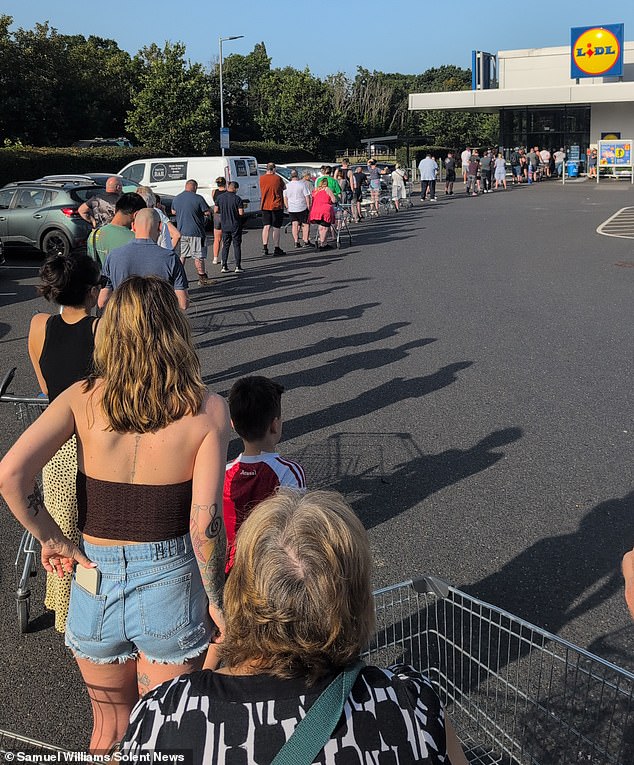

Huge queues snaked outside supermarkets for bargain air conditioning units today as the UK’s record for the hottest ever June day was broken for the second day in a row.
The Met Office said a provisional temperature of 36.4C was observed this afternoon at Yeovilton in Somerset, just one day after Gosport in Hampshire hit 36.1C yesterday.
The June record had stood at 35.6C for half a century since 1976 until this week, and the scorching weather will continue tomorrow as a rare red warning was extended.
Dozens of people queued across a Lidl car park in Southampton for over an hour this morning as they tried to buy £149 discount AC units in the exceptionally hot weather.
One employee said the units were ‘gone in 0.5 seconds’ with queues also reported at other Lidl branches across the UK and empty shelves where they had been placed.
Others reported that their local store had not received any deliveries, while some said people in front of them in the queue had bought six units in one go and it ‘kicked off’.
Shopper Samuel Williams said there was ‘a queue longer than I’ve ever seen’, adding: ‘It was stretching halfway across the car park. After joining the queue, I discovered that everyone there had been planning to buy an AC unit, with one woman saying she has two others at different Lidls in Southampton to try and maximise her odds.’
Stephanie Ridout arrived at a Lidl in Whiteley, Fareham, to buy flowers before work at around 8am today – and saw at least 50 people queuing to get into the store. She said: ‘As I pulled into the car park I was shocked to see the queue. The lady in front of me said people were queuing up for fans and air conditioning units for over an hour.’
Another retailer, Toolstation, said sales of AC units were up 220 per cent compared to the previous week, while cooling fans had risen by 333 per cent in the last week.
The Met Office said it had extended a rare red extreme heat warning for ‘population-wide adverse health effects’ and a ‘danger to life’ by another day until tomorrow.
South East England will remain under the warning, which was previously issued for yesterday and today – with highs of 36C in the shade and 38C in the sun tomorrow.
It comes as a swimmer died after going into the sea during a visit to Aberavon beach in Port Talbot, South Wales, at about 4.30pm yesterday. Coastguard personnel performed CPR but the 50-year-old man from nearby Cilfrew died at the scene.
Elsewhere a fire engine caught fire in the heatwave while travelling to a crash on the A350 at Charlton Marshall in Dorset at 6.30pm yesterday. The crew from Blandford fire station stopped the vehicle and managed to escape before calling for backup.
Two other crews from Wimborne and Sturminster Newton rushed to the scene to tackle the inferno which burnt out the engine’s cab – and the fire also spread to the nearby grass verge and telegraph cables before it was eventually put out by 8.30pm.
The blaze caused the engine’s tyres and cylinders, including breathing apparatus sets, to explode. Paramedics checked the crew but no one was hurt. Also today:
- Bridget Phillipson opened the door to changing school hours as 2,400 shut today;
- Trains were axed and commuters urged not to travel ‘unless absolutely necessary’;
- Supermarket fridges and freezers broke as infrastructure failed to work in the heat;
- Transport for London asked passengers to ‘consider if your journey is necessary’;
- Six NHS trusts in England have now declared critical incidents due to the weather;
- London Ambulance Service has highest ever total of life-threatening emergencies;
- The RAC said breakdown callouts were up 20 per cent on normal levels yesterday.
The Met Office said highs of up to 40C are possible this afternoon, meaning the UK could close in on the all-time temperature record of 40.3C set in July 2022.

People queue to get their hands on an air conditioning unit from a Lidl in Southampton today

A sign outside a Lidl store in Havant, Hampshire, confirming they had sold out of AC units

Empty shelves at a Lidl store in Hampshire where the air conditioning units had been placed


The units are now sold out nationwide, according to the Lidl UK website, which listed the own-brand budget units at just £149 each
Last night was also the UK’s warmest June night ever after overnight temperatures in Cardiff failed to drop below 23.5C, beating the previous record of 22.7C in 1976.
South East Water announced a hosepipe ban today for Kent, where it has 850,000 customers, which has come into force immediately after ‘record demand for water’.
Bosses said the move is to ensure the firm can provide water to all customers across the region as demand for drinking water has reached ‘very high levels’ for June.
It comes after thousands of people in Kent were left without drinking water or experienced disruptions to their supply around the May bank holiday weekend heatwave as South East Water grappled with issues following the soaring heat.
The ban will be enforced from July 3 but the company is urging customers to abide by it immediately. It means customers will not be able to use hosepipes or sprinklers to water gardens, wash cars, patios and boats, or fill swimming and paddling pools.
The firm said it is producing more than an extra 100 million litres of water a day, the equivalent to supplying three towns the size of Maidstone, but demand for drinking water needs to be reduced to avoid supply disruptions throughout the summer.
Anglia Water is asking its 2.2million customers in Norfolk, Cambridgeshire and Suffolk to stop using their hosepipes during the heatwave – but has stopped short of a ban.
Schools and nurseries across swathes of England and Wales have either closed or partially closed, with some bringing in early finishing times or relaxed uniform rules.
At least 1,600 schools in England and 840 in Wales were closed or disrupted during this week’s heatwave, according to analysis of council websites by BBC News.
In Guernsey, La Houguette Primary School helping pupils keep cool by moving some lessons to a Nazi bunker built when the island was occupied during World War Two.
Transport networks have faced major disruption and people are being urged to stay inside between 11am to 3pm, close windows and curtains and stay hydrated.
Portsmouth’s Queen Alexandra Hospital declared a critical incident following a failure to its cooling system supporting ‘critical infrastructure’, as did Norfolk and Norwich University Hospitals NHS Trust after its MRI scanners stopped working in the heat.
Demand for air conditioners is soaring, with Asian manufacturers such as Samsung and LG stepping up production earlier this year in anticipation of hot temperatures in Europe, where Samsung said it has seen ‘double digit’ growth in demand.

People cool off at Clevedon Marine Lake in Somerset today as the heat warning is extended

A woman uses a fan to cool down during the extremely hot weather in London today

People cool down in Lyme Regis, Dorset, this afternoon as temperatures soar once again

Swimmers enjoy cooling off from the heat at Charlton Lido in south-east London this afternoon

A man uses a fan to cool down while travelling on the Waterloo and City line in London today

People queue to jump off Bournemouth Pier in Dorset today as the extreme heat continues

A fire engine caught fire while travelling to a crash at Charlton Marshall in Dorset yesterday

People purchase an ice cream from a van in London today as the extreme heat continues

(From left) Susie MacDonald, Charlotte Reader and Emma Ledger cool off from the hot weather at Cumnock open-air swimming pool in East Ayrshire this morning

A person cools off at a water fountain by the beach in Hove, East Sussex, this afternoon

People cool off at Clevedon Marine Lake in Somerset today as the heat warning is extended

A man out in the sun on the grass at Leicester Square in London’s West End this morning

Several men attempt to ride an RNLI jet ski rescue sled off Bournemouth pier in Dorset today

Rowers on the River Thames at Maidenhead in Berkshire this morning as the heat continues

(From left) Bruce Ferrol, six, and brother Wallace, eight, at Cumnock pool in East Ayrshire today

People cool off at Portishead Lido in Somerset today as the red weather warning is extended

The dried-up bed of the River Wharfe at Yockenthwaite in the Yorkshire Dales this morning

A person shelters from the heat otf he sun by sitting in a beach shelter in Hove this afternoon

Deer enjoy a morning swim in a stream at Richmond Park in south-west London today

England cricketer Jofra Archer wipes his face with a towel at Trent Bridge in Nottingham today
King Charles III was among those feeling the heat yesterday at a reception on climate change at St James’s Palace in London, which does not have air conditioning.
As he greeted delegates in the throne room, His Majesty was wafted with an electric fan held by Vice Admiral Sir Tony Johnstone-Burt , Master of the Household.
More than ten people were taken to hospital mostly for heat-related illnesses after a collision on the M25 in Surrey which caused long queues in unbearable conditions.
A double decker electric bus caught fire in a huge blaze at Westbourne Park depot in west London yesterday which also destroyed two electric vehicle charging points.
The BBC urged staff to avoid coming into the office, with an email ‘recommending that you consider working from home if you are in an area covered by the warning’.
London Mayor Sir Sadiq Khan also told ITV News: ‘I think all of us need to be aware this is dangerous. If you can, work from home, and it’s cool, working from home.’
And in Hampshire, Testwood Lakes near Totton in Southampton was closed off to the public as police marine units joined other emergency services to search for a 15-year-old boy reported missing after last being seen swimming at 1.35pm yesterday.
London Ambulance Service responded to 642 category one calls yesterday – the highest number of life-threatening emergencies in its history.
Category one calls include the most serious, life-threatening injuries and illnesses such as cardiac arrests and patients who are not breathing.
Chief executive Jason Killens KAM said: ‘We have seen the highest number of life-threatening emergencies in our history, driven by the extreme heat across London.
‘Our crews are working very hard in challenging conditions to care for patients and I would like to take this opportunity to thank all our people for their incredible hard work. Please help them to help you by taking care of yourself and others – stay out of the sun and keep hydrated.’
It was the fifth busiest day in the service’s history, with 7,900 calls in total and ambulance crews responding to nearly 3,600 patients in a single day.

Passengers make their way through a hot London Paddington railway station this morning

A Spider-Man fan in costume is cooled by a man while waiting for a promotional event for the upcoming premiere of the film ‘Spider-Man: Brand New Day’ in central London this morning

A contractor sits on bags of cement to drink water while working in the heat in Bristol today

Larry the cat, Chief Mouser to the Cabinet Office, outside 10 Downing Street in the shade today

Thia Gordon Shirley, eight, swims underwater at Charlton Lido in south-east London today

A woman shelters from the sun outside Canary Wharf station in east London this morning

A construction worker in Wimbledon, south-west London, on a scaffolding platform today

Sunrise this morning on Glastonbury Tor in Somerset as the heatwave continues today

Towels and blankets are used to block the sun so pets are kept cooler at a home in Bristol today

Sunrise this morning in Dunsden, Oxfordshire, at the start of another very hot day for Britain

Vice Admiral Sir Tony Johnstone-Burt, Master of the Household to the Sovereign, holds a fan for King Charles at a London Climate Week reception at St James’s Palace in London yesterday


South East Water announced a temporary hosepipe ban for people living in Kent from today
As the hosepipe ban was introduced in Kent, South East Water chief executive David Hinton said: ‘We know how frustrating it is to hear that restrictions are coming into place.
‘Our teams have worked incredibly hard to prepare for this summer, but the sheer scale of this sustained heatwave means drinking water is being drawn from our storage tanks faster than it can be treated and refilled.
‘To safeguard that shared supply and prevent any homes from facing a sudden loss of water, we sadly need to ask our communities to not use their hosepipes immediately.
‘We are deeply sorry for the disruption this causes, and we are incredibly grateful to everyone helping us protect Kent’s water.’
The company said to ensure customers have water ‘every available water treatment works and source is currently producing treated water at full capacity’.
There has also been a rise in the number of teams fixing burst pipes and leaks to save water.
But it added: ‘The impact of this summer heatwave is affecting drinking water storage levels right across Kent, requiring a county-wide approach to restrictions.’
Mr Hinton has announced plans to resign as the company’s chief, just days after former chairman Chris Train also stepped down, following a scathing report into a series of outages by MPs, who said they had ‘no confidence’ in the company’s leadership.
It came in the wake of thousands of customers being left unable to access tap water, shower or flush their toilets during outages between November and January.
Since then John Halsall has been announced as South East Water’s incoming chief executive who will take over from Mr Hinton after regulatory approval and a handover period.
The Met Office said the exceptional heat will spread northwards today, ‘with an even hotter day ahead for some with amber and red extreme heat warnings in force’.
However some places might feel slightly cooler due to a brisk breeze in the south.


Red warnings for extreme heat have been issued for an area from London and the south coast to Swansea, Somerset and Birmingham until midnight tonight.
Tomorrow’s red warning then covers South East London.
The forecaster warned that ‘significant disruption to daily life is likely’. If temperatures reach 39C, that would make it the second hottest day in the UK on record.
If 38C is recorded, that is still in the top five days ever recorded and hotter than any day of the 20th century.
Met Office chief meteorologist Andy Page said: ‘This exceptional spell of hot and humid weather will maintain its grip on the UK for a little longer.
‘Although the current red warning for areas in more central and western parts of England and Wales will expire later today, the heatwave will still be bringing high temperatures to these areas, albeit moving away from the peak heat of Wednesday and Thursday.
| 1 | 40.3C | July 19, 2022 | Coningsby, Lincolnshire |
| 2 | 38.7C | July 25, 2019 | Cambridge |
| 3 | 38.5C | August 10, 2003 | Faversham, Kent |
| 4 | 38.2C | July 18, 2022 | Pitsford, Northamptonshire |
| 5 | 37.8C | July 31, 2020 | London Heathrow |
| 6 | 37.1C | August 3, 1990 | Cheltenham, Gloucestershire |
| 7 | 36.7C | July 1, 2015 | London Heathrow |
| 8 | 36.7C | August 9, 1911 | Raunds, Northamptonshire |
| 9 | 36.6C | August 2, 1990 | Worcester |
| 10 | 36.5C | July 19, 2006 | Wisley, Surrey |
‘We are expecting that some daytime maximum temperatures could exceed 36C, perhaps rising to 37C in some locations.’
The daytime heat will be accompanied by high humidity. Mr Page added: ‘Significant disruption to daily life is likely and the public should take every effort to adapt their daily routines to cope with these levels of heat, which up to now have been extremely rare for the UK.’
The heatwave has led to health warnings, school closures and transport disruption.
It is driven by a ‘heat-dome’ settling over western Europe that has brought extreme conditions across the continent.
Red heat health alerts have also been issued by the UK Health Security Agency (UKHSA) for the East of England, East Midlands, London, the South East, the South West and the West Midlands. Amber heat health alerts were activated for the North East, North West, and Yorkshire and The Humber.
These alerts are in place until 11pm tomorrow, and mean ‘adverse temperatures are likely to impact on the health and wellbeing of the population’.
The Met Office has also issued an amber warning for heat tomorrow covering much of England, while a yellow warning for thunderstorms is in place for the South West this evening.
And with the extreme heat set to linger in some parts of the country into the weekend, the Met Office has issued an amber warning for extreme heat covering parts of East and South-East England on Saturday.
Night time temperatures have also been unusually high, staying above 20C in many places – with the so-called ‘tropical nights’ making it harder to sleep and for people to recover from the heat of the day.
As the heatwave eases, the Met Office said the East and South-East of England will retain the warmth the longest, although there should be a climbdown in temperatures by Saturday, with peaks around 32C likely.
Next week, a more westerly influence on the UK’s weather is expected, with a return to more average temperatures for the time of year and a mixture of winds and rain, particularly in the northwest, the weather service said.
Travel into central London continued to be down today compared to last week as workers heeded advice to stay at home during the heatwave.
Data from O2 showed travel to the West End was 13 per cent lower today compared to last Thursday, down by 10 per cent in the City, and by 19 per cent in King’s Cross.
Train passengers are being urged to only travel if ‘absolutely necessary’ in areas most affected by extreme heat.


Network Rail said trains will operate at reduced speeds and services will be cut for ‘safety reasons’.
Heat-related issues that can affect the railway include buckled rails, sagging overhead electric wires and lineside fires.
Network Rail urged passengers to ‘only travel if absolutely necessary’ if at least part of their journey is within the Met Office’s red warning zone today, and amber warning zone tomorrow.
Today’s red zone covers large parts of southern England and southern Wales, while tomorrow’s alert stretches from the South East up to the North West and South Yorkshire.
Anyone travelling elsewhere on Friday ‘should still check before they travel’, Network Rail said. Steel rails can exceed 50C when the air temperature is 30C.
Jake Kelly, deputy chief executive of Network Rail, said: ‘We know how important it is for people to get where they need to be, but this spell of very hot weather will make journeys more challenging across the network.
‘Very high temperatures, like we are seeing in Great Britain and across parts of Europe, put significant strain on the railway, so our priority is to keep passengers safe while keeping services running.
‘We’re asking passengers to think carefully about their plans and only travel if it’s absolutely necessary in the areas most affected areas by the extremely high temperatures that are being recorded.’
Passengers who do need to travel are being urged to plan ahead and carry a bottle of water.
Eurostar said four trains between London St Pancras and Paris Gare du Nord were cancelled today ‘due to expected adverse weather’ on the network.
Transport for London (TfL) told customers to ‘consider if your journey is necessary’ and said they should expect ‘very hot weather tomorrow until Friday night’.
Chiltern Railway is running fewer than half its usual services between today and tomorrow.
This affects London Marylebone services to and from Birmingham, Oxford and Aylesbury via Amersham.
The operator acknowledged ‘there may be significant delays and very busy conditions’.
Avanti West Coast has cut one train per hour on its Birmingham, Liverpool and Manchester routes between Tuesday and tomorrow.
LNER, which runs services on the East Coast Main Line, told passengers ‘we strongly recommend that you do not travel’ today or tomorrow, and those planning to take a train on Saturday should check for service updates.
Many operators have eased restrictions on tickets, meaning they can be refunded without a fee or used on alternative dates.
On Tuesday afternoon, more than 200 passengers were evacuated from a Great Northern train travelling from Moorgate to Stevenage after it broke down during the heat.
It comes as the London School of Economics was forced to cancel a flagship climate conference on dealing with extreme heat yesterday.
The university had been set to hold ‘Extreme heat: improving governance and strengthening action around the world’ in its Shaw Library – but last night said it ‘did not have any cooling mechanisms in place’.
‘We cannot risk the wellbeing of speakers or guests by subjecting everyone to very unpleasant indoor conditions,’ it added.
Meanwhile, the All England Club was forced to suspend Wimbledon qualifying after its automated line-calling system malfunctioned.
Players were taken off court after it was decided chair umpires could not make line calls, and there are no reserve judges available during qualifying.
Provisional figures suggest the temperature reached 36.1C in Gosport, Hampshire, yesterday breaking the previous June record from the summer of 1976.
The heatwave forecast is set to continue today and tomorrow, and the Met Office said it is possible the figure could be ‘beaten again’.
Yesterday’s high breaks the previous top temperature for June of 35.6C in 1976 and 1957.
The first record-breaking temperature recorded yesterday was in Charlwood, Surrey, which reached 35.7C.
The figure was surpassed by provisional temperatures of 35.8C at Wiggonholt, West Sussex, 36C in Wisley, Surrey, and then 36.1C in Gosport.
Figures are currently provisional and will be verified at the end of the heatwave to check if it is a new national record.
Met Office science manager Amy Doherty said: ‘If confirmed, a new June daily temperature record would be significant, especially following on the heels of the recent records set in May.
‘The new record provides further evidence that temperatures previously considered extreme are becoming increasingly common as a result of human-induced climate change.’
Education Secretary Bridget Phillipson has said parents should send children to school if they remain open, saying schools were taking steps to help pupils cope with the heat, and absences had a cost.
‘I know hot weather can be a struggle. But my message to families is simple: if your child’s school is open, you should keep sending them into school,’ she said.
Ms Phillipson was also asked on BBC Radio 4’s Today programme whether she was considering changing the hours of the school day or time of the school year to avoid the heat.

UK Health and Security Agency red and amber heat health alerts which are in place today
She replied: ‘I think we need to keep all of that under review as we see how things change and the kinds of extreme of temperature we’re seeing are deeply concerning.
‘But we need to be led by the evidence around all of that and it’s just really important that these children are in school.’
During a visit to Beanfield Primary School in Corby, Northamptonshire, today, Ms Phillipson also said: ‘Schools have had a difficult time of it in that we saw a huge backlog building up over many many years, schools crumbling, we had the Raac (reinforced autoclaved aerated concrete) crisis.
‘There’s been a big job of work left in order to really make sure that all our schools are modern buildings that are able to deliver a brilliant education for our children.
‘We are investing a lot of money in making that a reality, but I think the challenges that schools are facing around the extreme weather at the moment demonstrate that there’s more to do.’
The Government allocated £2.4billion in 2025/26 to improve the condition of the school and college estate.
Sir Keir Starmer said schools have to decide for themselves whether it is right to close early as a result of the heatwave.
Asked if it was right that children’s education suffer because of the extreme weather, the Prime Minister said: ‘It is very hot, and obviously schools will have to take the appropriate measures, and each school will gage for themselves the measures that are appropriate.
‘But it is important that we as a Government co-ordinate this across the country, and actually with all of the countries within the United Kingdom, which is what we’re doing.’
Cobra meetings are taking place ‘at the official level’, Sir Keir said, adding: ‘Obviously it falls to me and others to say, take care, be sensible with precautions, and schools are going to have to decide. They are deciding.’
The heatwave has prompted new calls for the Government to take more action to protect the UK from increasingly extreme heat – including cooling for hospitals, schools and care homes.
The Met Office said the frequency and intensity of heatwaves has increased worldwide.
Professor Stephen Belcher, Met Office chief scientist, said: ‘Human induced climate change has made events like this more likely and more intense. To see temperatures like this in the UK in June is sobering.
‘Events like this bring home the implications of climate change, with very high temperatures and humidity bringing significant health implications from heat stress, as well as impacts to a range of sectors such as transport, energy and water supply.’
Meanwhile new research suggests almost one in five employers have no measures in place to help workers cope with the heatwave.
Many employers are taking steps to respond, but the response to the hot weather has been uneven, said the Chartered Management Institute (CMI).
Its survey of 1,000 managers found that a third said their company had relaxed dress codes, while a quarter said flexible working hours were being offered.
A minority of respondents reported wellbeing measures such as free refreshments, additional breaks and reduced workloads or adjusted expectations.
Almost one in five said their employer has no measures in place at all.
Petra Wilton, director of policy at the CMI, said: ‘As the UK continues to struggle with a productivity crisis, there’s a new challenge: extreme heat.
‘Britain’s workplaces were built for a different climate, and as periods of extreme heat become more common, many organisations are finding that higher temperatures can have a real impact on concentration, productivity and day-to-day performance.
‘Businesses have a duty to protect the wellbeing of their staff and effective managers should be checking on vulnerable employees, such as pregnant staff, older workers or those with health conditions and ensuring employees are encouraged to speak up if they are struggling.
‘For outdoor workers, expectations need to be reviewed and access to fresh water, shade and regular breaks is a must.’
Almost half of those polled said the heatwave had negatively impacted productivity at their work.
The Royal College of Physicians (RCP) said doctors have described severe, unsustainable pressure on the workforce, with very few settings having air conditioning, staff ‘really struggling’ and resident doctors battling the heat while sleep deprived.
The RCP also said there have been reports of patients on geriatric wards facing temperatures of up to 35C and one physician saying their care setting is ‘unfit to cope’ with the heat.
One physician said their hospital had ‘called a critical incident due to multiple areas with machine problems’, the RCP said.
Testing laboratories were in difficulty and two linear accelerator machines, used to treat cancer, had stopped due to the heat, according to the RCP.
They were working in a relatively new care setting ‘tacked on to an old Victorian hospital’, creating further infrastructure challenges. ‘It’s hopeless really,’ they said.
They also faced ‘major issues’ with their IT servers because of the temperatures. They said: ‘We thought we were going to lose everything, so we were all asked to turn off non-essential computers and electrical equipment, including lights.’
Another physician said: ‘Lots of people, especially older patients, are turning up having collapsed or with dehydration. In terms of inpatients, the conditions are awful due to overcrowding. Very few places have air conditioning and staff are really struggling.’
A 2025 snapshot survey of RCP members found 58 per cent of physicians feel their workplace is unprepared for extreme weather events, while 75 per cent are concerned about the impact of climate change on the health of their patients.
Dr Hilary Williams, RCP clinical vice-president, said: ‘This week, physician colleagues across the country have told us the significant impact the heat is having on them, their patients and their teams.

The heatwave threshold is defined as three consecutive days at or above a set temperature
‘There are reports of older patients arriving at hospital having collapsed or with dehydration. Patients are facing overcrowding, and there are issues with machines, laboratories and kidney dialysis – all fundamental to providing safe patient care.
‘The impact of heatwaves on staff cannot be overstated. There is a sense of foreboding when we see the weather forecast, because we know what is to come, and there is very little staff can do.
‘It is not as simple as buying fans, which can present a fire risk when used alongside oxygen, and may increase the spread of infection. The NHS is already facing enormous pressure from rising demand and workforce shortages. Coupled with an ageing estate, these challenges intensify during extreme weather.
‘As clinicians, there are immediate steps we can take to protect patients, such as reviewing medications that affect hydration and ensuring they are stored appropriately.
‘But this must be matched by system-level change – strengthening infrastructure and embedding resilience into NHS reform. Buildings must be upgraded to withstand extreme heat and other climate risks.
‘Hospitals should be places of safety, not settings where extreme heat puts patients and staff at risk.’
Much of the rest of Europe is also in the grip of a heatwave today which has already claimed dozens of lives, disrupted power supplies and shut schools and cultural landmarks.
Temperatures in Paris hit a June record of 40.9C yesterday, a day after France recorded its hottest day since records began nearly 80 years ago, when temperatures peaked at 44.3C in the south-western town of Pissos.
Italy’s health ministry placed 16 cities – including Florence, Milan, Rome, Turin and Verona – on its highest heat alert, and warned the heatwave could intensify further, peaking between Sunday and Monday.
At least 48 people have died in France from drowning since the onset of the heatwave while trying to cool off, authorities said, and two young children were killed by heat in a car.
Spain reported two elderly people had died of heatstroke after days of temperatures exceeding 40C.