
Shakira officially opened the 2026 World Cup on Thursday as the soccer extravaganza kickstarted amid a backdrop of turmoil that threatens to derail the tournament.
Following months of excitement, the biggest World Cup in history has officially arrived in North America with thousands of fans descending on the United States, Canada and Mexico to watch their beloved teams in action.
In a repeat of the opening match from 2010, Mexico will kickstart the blockbuster tournament against South Africa at the iconic Estadio Azteca in Mexico City on Thursday afternoon.
Yet, before the first whistle was even blown, fans were treated to an eye-catching display of action.
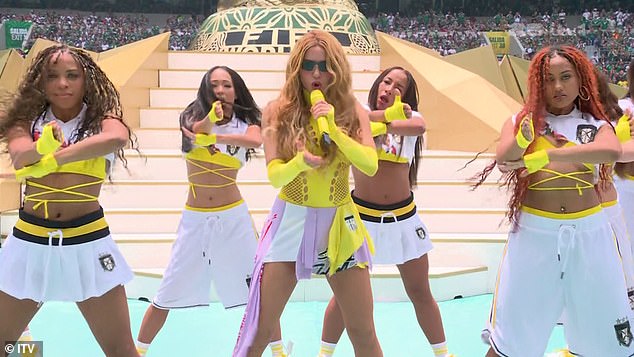
Before the opening match kicked off, Colombian songstress Shakira and Burna Boi performed ‘Dai Dai,’ the official song of the 2026 FIFA World Cup, headlining the opening ceremony.
The performance was a spectacle of color and sound. Hundreds of dancers joined the ‘Hips Don’t Lie’ hitmaker, who wowed in a neon yellow bodysuit and white miniskirt, on the stage at the center of the field.

Shakira officially kickstarted the 2026 World Cup in a star-studded opening ceremony

The Colombian joined Burna Boi to perform ‘Dai Dai’ the official song of the 2026 World Cup
Shakira, who also recorded the official anthem for the 2010 World Cup, serenaded fans in front of a giant gold trophy replica statue.
The jampacked show also featured performances from Alejandro Fernández, Belinda, Danny Ocean, J Balvin, Lila Downs, Los Ángeles Azules, Maná and Tyla – all of whom featured on the first-ever FIFA World Cup album.
However, while fans around the world were stunned by the performance, viewers in the United States were left furious when Fox, the official American broadcaster of the World Cup, failed to show the ceremony on its live coverage.
Instead, American fans tuning in to catch the high-octane performance were instead forced to listen to analysis from the network’s panel of Thierry Henry, Zlatan Ibrahimovic and Alexi Lalas.
It is currently unclear why the network decided to shun Shakira’s performance but Telemundo, the Spanish-language carrier of the tournament, broadcast the entire show.
Meanwhile, the US and Canada will host their own opening ceremonies ahead of their first games on Friday.
Canada will face Bosnia and Herzegovina in their opening clash in a freshly-transformed BMO Field in Toronto.
The stadium has expanded from 28,000 seats to 45,000 in preparation for the World Cup crowd.

The build-up to the opening clash has been marred by numerous protests in Mexico City

The World Cup kicked off with Mexico vs South Africa at the Estadio Azteca
And it will serve as the stage for Canada’s celebratory bash as the nation serves up some of the greatest talent that the Great White North has to offer.
Alanis Morissette, Alessia Cara, Jessie Reyez and Michael Buble among others will take to the stage before the tournament gets underway north of the border.
The USA’s opening ceremony will take place on the same day with the USMNT also getting their campaign underway on Friday.
The Stars and Stripes take on Paraguay in Los Angeles as they begin their first home World Cup since 1994.
Katy Perry, Future, Anitta, LISA, Rema and Tyla headline the pregame festivities in the City of Angels.
However, the build-up to kick-off has been dominated by a series of off-field controversies involving politics, cost, security and logistics ahead of the largest World Cup in history.
Mexico City itself encapsulates that contrast. There is pride at the country becoming the first to host World Cup matches across three separate tournaments following the 1970 and 1986 editions.
But behind that football excitement, there is a mix of genuine tension, with large-scale protests taking place across the capital.
The most visible demonstrations have come from members of the Coordinadora Nacional de Trabajadores de la Educacion, a teachers’ union protesting over pay, pensions and labour reforms.
Elsewhere, environmental and human rights groups, including Greenpeace, have staged protests about the environmental impact of a World Cup spanning 16 host cities and three countries.
Sections of the Mexican public are also unhappy about the costs associated with co-hosting the tournament when deep-rooted societal and economic issues remain unresolved. Some have argued the event primarily benefits wealthier sections of society, rather than the general population.
Meanwhile, the United States has also been rocked by controversy in the build up to the tournament amid outrage over the Trump administration’s visa policies.
Visa and entry issues have provided another source of controversy, with several fans, journalists and even officials having reportedly encountered problems obtaining visas or entering the US.

A teachers’ union is protesting over pay, pensions and labour reforms in Mexico City

There has been an increased security presence around the Estadio Azteca amid the chaos
The most high profile individual affected was Somali referee Omar Artan, regarded as one of Africa’s leading officials.
Despite being selected for the tournament, Artan was removed from FIFA’s list of referees after American authorities denied him entry upon arrival at Miami International Airport.
An official within the Donald Trump administration claimed this was due to Artan’s alleged ‘association with suspected members of terror organisations’.
Speaking to the New York Times, Artan said: ‘I am very, very disappointed. I’m just simply a referee who’s trying to live his dream, the biggest dream of my life, to come to the World Cup.’
Somalia is among the countries included on Trump’s travel ban list. Last month, he described Somali immigrants in the US as ‘all crooks,’ having previously labelled the African nation as ‘the worst country in the world’ in January.
The travel restrictions have attracted particular attention because they also affect qualified nations. Haiti and Iran are subject to full restrictions, while Ivory Coast and Senegal face partial restrictions.
The issue has brought geopolitical tensions into the World Cup. Iraq national team photographer Talal Salah was denied entry to the US, while the Iranian Football Federation claimed their allocation of tickets for fans had been revoked.
They added that some officials were denied visas, and Iran’s team are now required to enter and leave the US on matchdays.

FIFA President Gianni Infantino defended FIFA’s handling of the various issues on Wednesday
As a result, Iran switched their base from Arizona to Mexico shortly before the tournament, disrupting preparations.
The accumulation of these issues has led to some observers describing this World Cup as the most politically charged in history, despite FIFA’s attempts to position it as a unifying global event.
FIFA President Gianni Infantino claimed last year that ‘fans from all over the world will be welcome’ and only attracted more attention when pressed on visa problems, travel restrictions and ticket prices on Wednesday.
While defending FIFA’s handling of the situation, he argued that immigration decisions rest with governments rather than the governing body.
He similarly backed the ticket prices and claimed no-one else would have been able to secure Iran’s participation at the tournament given their conflict with the US.
He also urged his critics to ‘chill’ and ‘relax’.
‘We don’t live on the moon, we live on planet Earth,’ Infantino said. ‘We have to respect that we are not kings of the world, who can rule over governments and police forces.
‘We are a sports organisation that does as much as we can. It’s important sometimes to chill, relax. We work on everything. Sometimes screaming and shouting does not find a solution.’