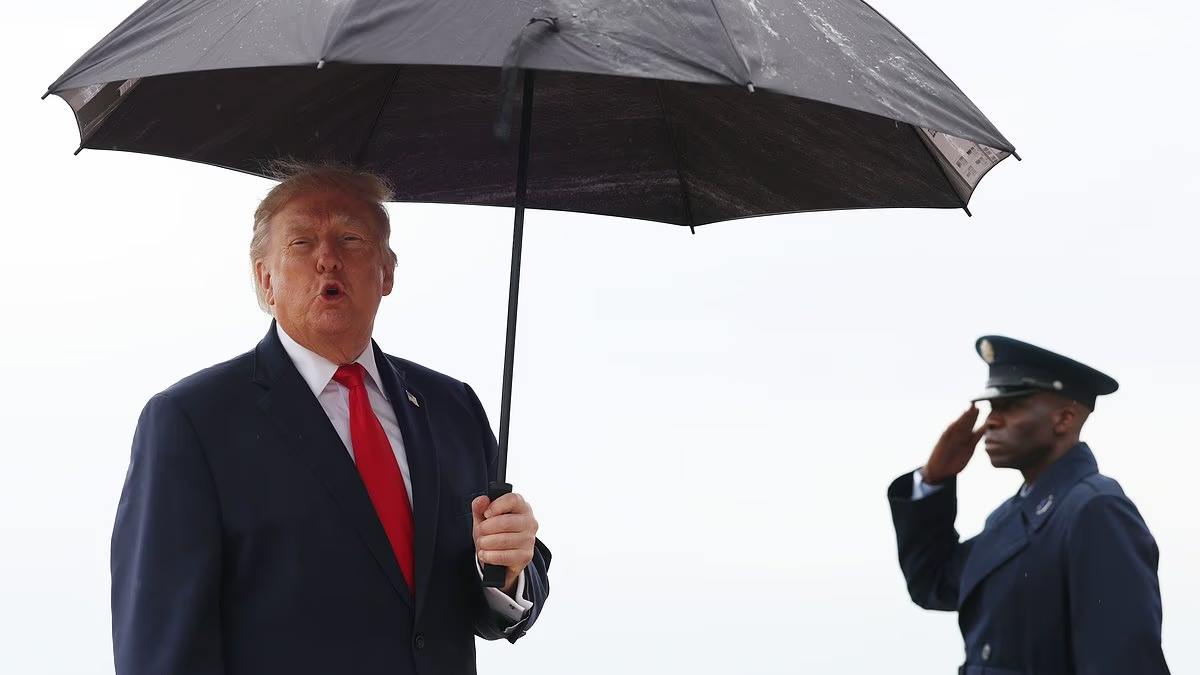

President Donald Trump said five times during a Sunday interview that a renewed US military campaign against Iran is “highly unlikely,” as negotiations over Tehran’s nuclear program and the Strait of Hormuz continue.
Speaking by phone with CNN anchor Jim Sciutto for nearly 20 minutes, Trump claimed there had been movement in talks aimed at resolving the standoff and restoring access to the strategically important waterway.
“It depends on whether or not they sign a very strong agreement,” Trump said. “But the answer is, it’s highly unlikely it’s going to be necessary.”
He portrayed Iran as an economically weakened country, pointing to what he described as “301 percent inflation” this year.
Trump again stressed that further military action was unlikely, while leaving open the possibility of ordering strikes if he believed they were required.
“I would, if necessary, but we hit them so hard. You don’t know how hard I hit them,” the president said. “So it’s unlikely I’ll have to.”
“They’re withering away financially. We’ve hit them militarily. We could finish them off,” he added.
Trump’s comments came only hours after Iranian Foreign Minister Abbas Araghchi warned Washington to accept Tehran’s latest proposal to end the conflict or prepare for a further escalation.

President Donald Trump said Sunday that renewed military action against Iran is “highly unlikely”

The remarks followed a warning from Iranian Foreign Minister Abbas Araghchi, pictured, that Tehran could escalate if the US rejects its latest proposal

Araghchi referred to the Republicans’ midterm losses in a warning posted on X
“American voters have made their choice. Time for the White House to make its own,” Araghchi wrote on X.
“Our two-day proposal stands: meet the requirement, including ending the war on all fronts, and you will see results. Or choose war, and see our alert and battle-hardened Warriors rain down hell.”
Araghchi and other Iranian hardliners have seized on Tuesday’s midterm results, viewing them as evidence that Trump’s political position has weakened. CNN reports that Tehran believes the outcome could make the administration more receptive to Iranian demands, including permission to continue its nuclear program, which officials say supports energy needs and helps maintain control of the Strait of Hormuz.
Vice President JD Vance has blamed the Iran conflict for the “blue tsunami” that saw Democrats take House and Senate seats and win governorships in traditionally Republican states.
“The reason we lost is the war. The President himself said so last night,” Vance wrote in a lengthy post on X on Wednesday.
Vance also issued a pointed challenge to supporters of the war, urging them to accept responsibility for encouraging US military involvement in the Middle East.
Asked that day about the poor election results, Trump appeared to acknowledge that the conflict had played a role.
“It is largely true,” he said, while insisting: “If I had to do it again, I would do it. You can’t let Iran have a nuclear weapon.”

Vice President JD Vance previously attributed the “blue tsunami” in part to the war in Iran
Trump has said that since the conflict began in February, US attacks have severely damaged Iran’s missile and drone forces.
CONTINUE READING: I Lied to My Children About Their Father—and Fear the Truth
During Sunday’s interview, he claimed Iran now has only 10 percent of its former missile capacity and 15 percent of its drone capability.
He also said Iran’s air-defense network had been effectively destroyed.
“It’s unstoppable because they have no anti-aircraft stuff. All of their anti-aircraft is gone,” Trump said.
US sanctions have further restricted Iran’s ability to sell crude oil internationally, while billions of dollars in Iranian assets remain frozen in overseas banks.
“Most likely, it will not be necessary,” Trump said again when asked about new strikes. “They want to make a deal so badly.”

Iranian missiles are displayed at the Islamic Revolutionary Guard Corps Aerospace Force Museum in Tehran

The United States has maintained a blockade in the Gulf of Oman. Smoke rises from the stern of a St. Kitts-flagged cargo ship after US Central Command said it attempted to break through

Trump said Sunday that a task force targeting Tehran’s land routes for advanced weapons, sanctioned materials and illicit funds is now operating
At the same time, Washington is offering up to $20 million for information about Iran’s nuclear program and has launched a task force to disrupt Tehran’s overland movement of advanced weapons, sanctioned goods and illicit revenue.
Trump announced on Truth Social that the operation, known as Iron Gate, is “in full effect in the Islamic Republic of Iran.”
“Coupled with history’s greatest Naval Blockade, very little gets into, or out of, Iran!” he wrote.
The president has also emphasized that American forces remain positioned across the Middle East should he order another attack.
“I’ve got three aircraft carriers here,” Trump told CNN. “The other one just arrived. We have three. They’re fully locked and loaded.”
Trump said potential targets include Iranian infrastructure such as power stations and bridges.
“We have 38 bridges in our sight that we can knock down in literally one hour; they’ll all be down,” he said, while adding that he would rather avoid destroying key infrastructure.
“I don’t want to do that, because essentially, it’ll take 10 years to rebuild them.”
“I don’t like ripping down bridges,” Trump continued. “And the hardest thing to build is a bridge. It takes years, and I’m a good builder.”

Trump said Sunday that three US aircraft carriers are deployed in the region. The USS Theodore Roosevelt is pictured on Friday
Diplomatic efforts across the Middle East have intensified since the midterm elections.
Qatar said Friday that Trump had spoken with Emir Sheikh Tamim bin Hamad Al Thani about reducing tensions. A day earlier, Araghchi held discussions with officials from Saudi Arabia, the United Arab Emirates, Oman, Pakistan, Kuwait, Jordan, Turkey, Cyprus and Qatar.
As part of the negotiations, Iran has offered to reopen the Strait of Hormuz, a crucial route for global oil shipments whose closure has pushed fuel prices higher. Tehran is seeking several concessions in return, including the lifting of US sanctions and the release of billions of dollars in frozen Iranian assets.