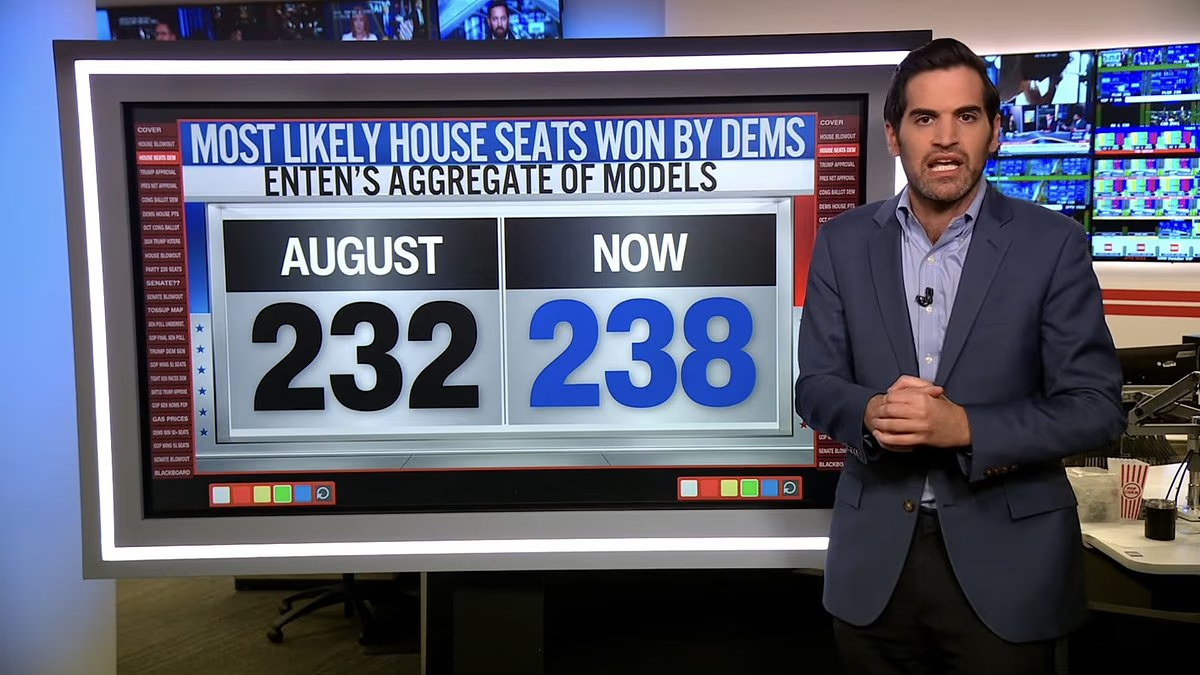


Democrats may be on course for a decisive midterm election victory that could wrest control of Congress from Republicans, according to CNN’s leading polling analyst. CNN chief data analyst Harry Enten said the latest figures point to a potentially damaging night for President Donald Trump’s party. In a dramatic forecast delivered Sunday, Enten said Democrats appeared well positioned to make major gains in the House of Representatives and were also favored to secure a comfortable Senate majority. With the November elections just over a week away, he suggested the fight for control of Capitol Hill may be less competitive than some observers expect. Instead, his analysis points to the possibility of a heavy Republican defeat that could significantly alter the balance of power in Washington. “The midterms are just days away and I’m pouring over hundreds, no thousands of polls and data points,” Enten told viewers. “And you know what the numbers are telling me? They are telling me that we are heading towards blowout territory! My goodness gracious!” The CNN analyst emphasized that his forecast was based on statistical modeling, not personal political views.
Enten sees 71% chance of blowout

“And of course, don’t be angry with me because the numbers do the talking and I just listen,” he added. Enten began with the House, where Democrats are hoping to turn voter dissatisfaction into enough gains to end the Republican congressional majority. His forecast put the odds of Democrats winning at least 230 House seats at 71%, a result he described as a “blowout.” “The chance of a House blowout is 71%, 71%,” Enten said. “Now, there’s a 29% chance that it doesn’t happen, right? But 71% things happen more often than 29% things!”
Democrats hold the blowout edge

“I know enough of math to know that.” The outlook appeared even worse for Republicans when Enten broke down which party was most likely to achieve such a commanding majority. His analysis gave Republicans only a 2% chance of winning at least 230 House seats, compared with a 69% chance for Democrats to reach that mark. “We haven’t seen the type of error necessary for Republicans to actually blow out the Democrats,” Enten said. “What we’re talking about here is that Democrats are really the ones who have the real chance of blowing out the Republicans.”
SEE ALSO: Elon Musk’s $1 Billion Investment Puts CNN and Paramount in Focus
Democrats eye Senate cushion beyond 51

Enten called the Democratic outlook “a very, very nice 69% chance.” Such a result would be a significant setback for Trump, potentially giving Democrats the numbers to challenge his legislative agenda and increase congressional scrutiny of his administration. Enten then turned to the Senate, where the race for control has been among the most closely watched contests of the election cycle. His forecast again offered Democrats an advantage. According to the analysis, Democrats had a 57% chance of winning at least 52 Senate seats—more than the 51 needed for a majority and enough to provide an additional seat of breathing room.
Democrats lead, but GOP remains viable

“It’s a 57% chance that Democrats win,” he explained. “Not just a majority in the United States Senate, but a majority with room to spare in the United States Senate.” Still, Enten cautioned against ruling out Republicans. His forecast gave the GOP a 24% chance of winning at least 51 Senate seats, meaning a clear Republican victory remained possible despite the Democrats’ statistical advantage. Taken together, the figures indicated an 81% probability that either party would finish with a Senate majority larger than the narrowest margin.
A one-in-five chance of a cliffhanger

That left a 19% chance of an exceptionally tight race in which control could hinge on a single contest. “So yeah, look, there’s a 19% chance, right? On the other side of this coin that we’re really down to the wire, when we’re really counting the ballots and one state is ultimately going to decide things on election night,” Enten said. “It’s possible, but it’s only about a one in five chance.” He concluded that the most likely result was a Senate majority with at least one seat to spare, rather than an outcome decided by the slimmest of margins.