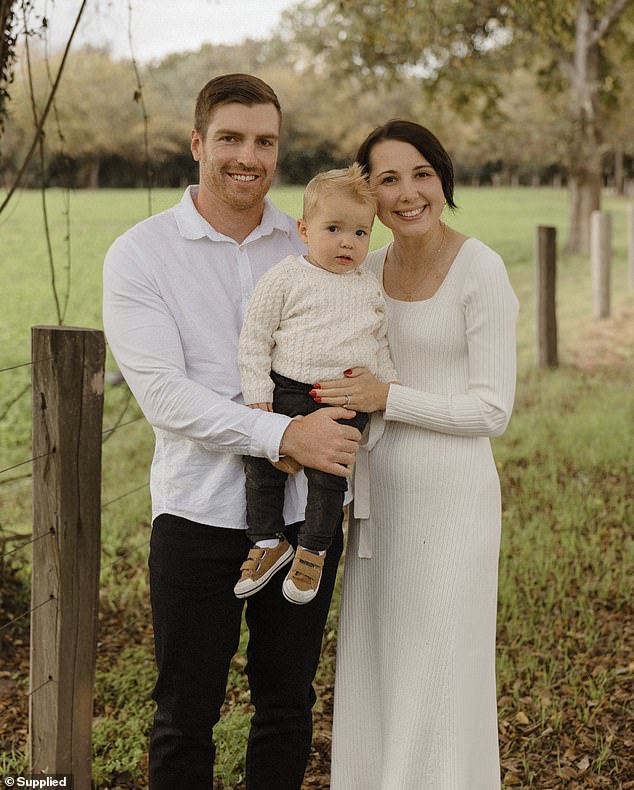

When Kaitlyn Alexander put her nine-month-old son Cooper down to sleep, she thought it was just another ordinary night.
But things took a distressing turn when the Sydney mum began coughing up blood.
At first, Kaitlyn tried to steady herself. She may look healthy, but she can spend up to two hours a day on medication, physiotherapy and treatments just to stay well enough for the next day. She has cystic fibrosis, a genetic life-shortening condition she has lived with since birth.
The young mum had experienced small bleeds over her life, but this time was different – the blood kept coming.
‘It felt like I was drowning in my own blood from my lungs,’ Kaitlyn told Daily Mail.
By the time paramedics arrived, they estimated Kaitlyn had already lost between 400mL and 500mL of blood.
‘I genuinely didn’t think I would even make it to hospital,’ she said.
‘It was really confronting, especially knowing my son was asleep in the next room.’
The mum, now 29, spent three weeks in hospital after the terrifying episode. Within days, it happened again. Doctors measured another half a litre of blood loss before rushing her into surgery for an embolisation, a procedure used to block the blood vessels causing the bleed.

When Kaitlyn Alexander put her nine-month-old son Cooper down to sleep, she thought she was ending an ordinary night of motherhood

To the casual observer, Kaitlyn looks healthy. But strangers would never suspect she spends up to two hours a day on medication, physiotherapy and treatments just to stay well enough for the next day
After the first surgery, Kaitlyn recovered in ICU. Then it happened again.
Doctors performed a second embolisation after a third major bleed.
‘That was probably the first time I actually thought I was going to die,’ she said.
‘I didn’t expect to come out of that hospital, which was really scary. I had a nine-month-old baby waiting for me at home.’
But surviving the hospital admission was only the beginning.
When Kaitlyn finally returned home, the fear followed her into every part of motherhood.
She was too afraid to bend over, to empty the dishwasher, to hang out the washing. She worried that one wrong movement or awkward position might trigger another life-threatening bleed.
She was even scared to lift her baby son Cooper, rock him to sleep or play with him the way she had before.

Kaitlyn, now 29, spent three weeks in hospital after the terrifying episode. Within days, it happened again
‘Before that, I had done everything for him,’ she said.
‘I’d put him to sleep, I’d play with him, I’d roll around and jump around with him. But after that, I was too scared to do anything at all.’
Even sleep felt dangerous. For months, Kaitlyn slept sitting upright because she feared lying flat might set off another bleed.
‘It took a very long time to process,’ she said.
‘I had to work with a psychologist to move past a lot of that anxiety. Every now and then, I still get nervous that I’ve pushed myself too hard, or that fear is always in the back of my mind.’
Kaitlyn had known illness all her life.
She was diagnosed with cystic fibrosis when she was six weeks old after a newborn heel-prick screening test. As a baby, she was in and out of hospital.
She grew up dancing and playing sport because keeping active helped keep her lungs as healthy as possible.

Kaitlyn grew up dancing and playing sport because keeping active helped keep her lungs as healthy as possible
But by high school, her condition became harder to ignore.
Friends could miss a few days of school with a cold and return quickly, but Kaitlyn would lose a week or two because her body could not recover as easily. She needed daily physiotherapy, airway clearance, medication, and time off for hospital appointments.
As a teenager, the weight of being different settled heavily on her.
‘No one else had to do all these extra things every day just to survive – it was just me.’
Kaitlyn had always known her life expectancy was not the same as her friends’, and she described it as a number hovering over her head.
‘I didn’t let it stop me,’ she said.
‘I still went to uni, I got married, I travelled and I had a baby. I’ve really tried hard to not let it stop me from accomplishing all the things I wanted to do.’
She said she refused to live as though time could be wasted.

Kaitlyn had always known her life expectancy was not the same as her friends’, and she described it as a number hovering over her head
‘If it is a shorter life, I want to make sure I’m doing everything I want to do. I don’t want to have any regrets,’ she said.
In 2022, Kaitlyn started taking Trikafta, a breakthrough cystic fibrosis medication that changed her body almost immediately.
Within hours, she noticed she could breathe more easily. Within two weeks, she felt like a different person.
‘I never realised how easy it should have been to just breathe,’ she said.
But routine blood tests soon revealed her liver was not tolerating the drug. Kaitlyn had no warning signs or symptoms – and had felt better than she had her whole life. However, her medical team reduced the dose, but her liver still could not cope.
She had to stop taking it.
‘If I stayed on it, my liver just would have failed,’ she said.
‘Trikafta improved my quality of life so much. To have that better future ripped away broke my heart.’

‘I still went to uni, I got married, I travelled and I had a baby. I’ve really tried hard to not let it stop me from accomplishing all the things I wanted to do,’ she said
Shortly afterwards, Kaitlyn married and went on her honeymoon. When she returned, she found out she was pregnant.
For years, she had wondered whether she would ever be able to have children biologically. She did not know if cystic fibrosis would affect her fertility or whether her body would be strong enough to carry a pregnancy.
She and her husband had discussed it early in their relationship – they knew they wanted children, whether through IVF, adoption, or natural conception.
Finding out she was pregnant was joyful, but frightening.
‘I was obviously excited, but from a health perspective, I wasn’t really sure how my body was going to cope,’ she said.
Her pregnancy was mostly smooth, though she struggled to gain weight. Across the entire pregnancy, Kaitlyn gained only about five kilograms, while Cooper was born weighing 4.1 kilograms.
‘Most of the weight was just baby,’ she joked.

In 2022, Kaitlyn started taking Trikafta, a breakthrough cystic fibrosis medication that changed her body almost immediately
The hardest part was keeping up with the treatments that kept her well. Morning sickness, fatigue and the physical pressure of pregnancy made airway clearance, physiotherapy and exercise more difficult.
After Cooper was born, the demands became even heavier.
Like any new mother, Kaitlyn was exhausted. But every spare half-hour carried a choice: sleep, eat, feed the baby, or complete the treatments her body needed.
‘Any half an hour I got to myself, I wanted to nap,’ she said.
‘I didn’t want to spend it doing treatments.’
Breastfeeding added another challenge. Kaitlyn already struggled to maintain weight, and producing enough milk while keeping herself nourished felt relentless.
‘I felt like I was constantly eating just to keep up,’ she said.
‘The main thing was having time to look after myself, not only as a new mum, but as a new mum with CF.’
Then came the night she coughed up blood.

For years, she had wondered whether she would ever be able to have children biologically
The episode left Kaitlyn physically weakened and psychologically shaken. It also forced her to confront a reality many people do not see when they look at her.
‘That’s a really big thing people don’t understand,’ she said.
‘You would never know by looking at me that I have CF.’
She said cystic fibrosis treatment is not one-size-fits-all. Medications that transform one person’s life may not work for another. Trikafta gave Kaitlyn a glimpse of a different future, but her body could not tolerate it – that is why she believes research remains critical.
‘There are still people that Trikafta left behind,’ she said.
‘We need to keep raising awareness and raising money for research, to find treatments that actually work for those people.’
For Kaitlyn, the goal is simple: more options, fewer limitations, and a future where people with cystic fibrosis do not have to spend hours each day fighting to breathe.
‘I’ve tried to put my all into every day that I can,’ she said.
‘I just don’t want to feel like I’ve wasted time.’