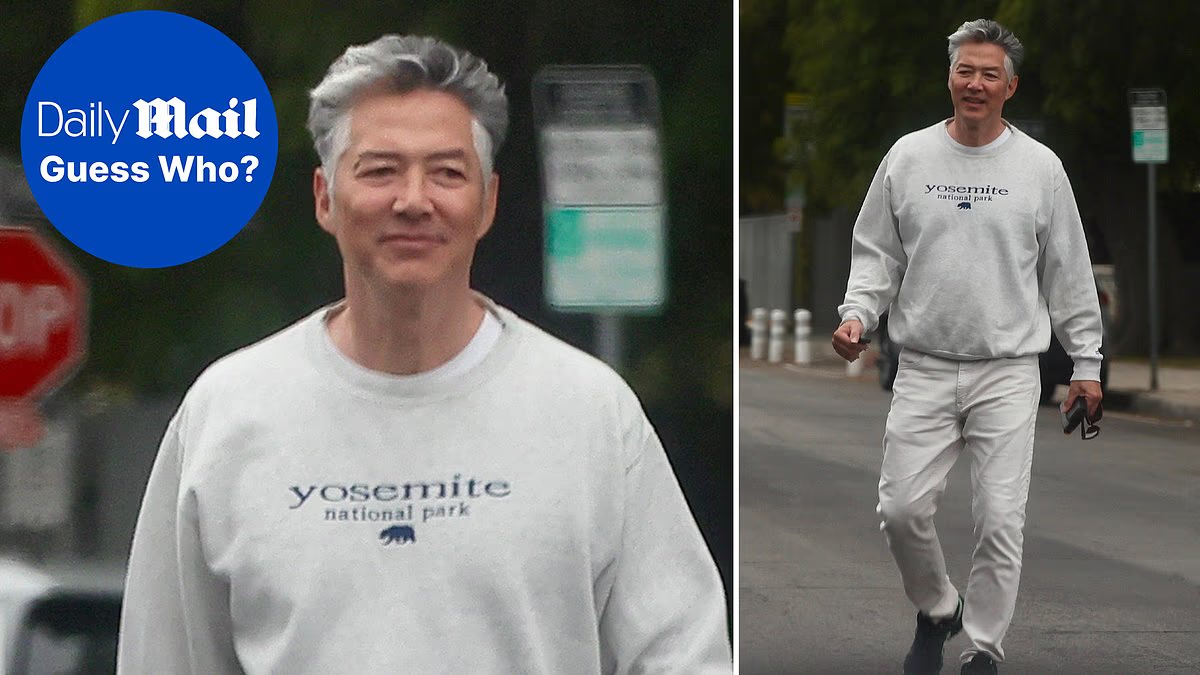

With his dark hair, leading-man looks and undeniable screen presence, this silver fox challenged Hollywood stereotypes in a string of popular films during the 1980s and 1990s.
Now 63, the actor still looks remarkably youthful. He cut a stylish figure in an all-white outfit during a rare Los Angeles outing while running errands.
He once dreamed of becoming the Chinese-American Tom Cruise. But with limited opportunities in the United States, much of his lasting success came through major international productions.
‘Thank God for Asia and starting out in Hong Kong first,’ the veteran actor said in 2019. ‘If my career was just here [in Hollywood] I’d have to do something else.’
Between prominent American film and television roles, he also appeared alongside some of Chinese cinema’s biggest stars, including Andy Lau, Gong Li, Zhang Ziyi and Li Bingbing.
So, can you guess the identity of this distinguished gentleman?

Still youthful at 63, this veteran actor appeared in several of Hollywood’s most popular films of the 1990s and was recently spotted running errands in Los Angeles

Between major film roles, his leading-man looks helped him build an impressive list of guest appearances on television series

This impeccably dressed star has maintained loyal fanbases in the United States and abroad for four decades—can you guess who he is?
It’s Russell Wong.
The charismatic performer appeared in American favorites including the family drama The Joy Luck Club (1993), the hip-hop crime films New Jack City (1991), alongside Wesley Snipes and Chris Rock, and Romeo Must Die (2000), co-starring martial arts icon Jet Li and the late rapper DMX.
Wong was born in Troy, New York, in 1963, the sixth of seven children. His father ran a Chinese restaurant, while his mother was a Dutch-American artist. After his parents divorced when he was very young, Wong moved to California with his mother at the age of seven.
He studied at Santa Monica College, the alma mater of James Dean and Arnold Schwarzenegger, where he trained in dance, attended acting classes and practiced martial arts.
At 22, Wong made his feature-film debut in Dennis Yu’s Chinese-language movie The Musical Singer.
He reached American audiences in the James Clavell historical epic Tai-Pan (1986), then landed leading roles in films from two indie auteurs: Abel Ferrara’s gritty romance China Girl (1987) and Wayne Wang’s charming romantic comedy Eat a Bowl of Tea (1989).
While opportunities on the big screen remained limited, his matinee-idol appearance helped him secure a notable run of television guest roles, including appearances on As the World Turns, The Equalizer and 21 Jump Street.
His later television credits include CBS hit NCIS, ABC’s High Potential and Netflix’s The Brothers Sun, where he appeared opposite fellow Asian cinema legend Michelle Yeoh.

Russell Wong attends the CineVegas Film Festival in 2005

Wong and Yu-Li Wu share a steamy scene in Wayne Wang’s The Joy Luck Club, the 1993 adaptation of Amy Tan’s best-selling multigenerational novel

Wong faces off with Jet Li in 2000’s Romeo Must Die, which also starred the late R&B singer Aaliyah and hip-hop artist DMX

Wong appears with actor-director Mario Van Peebles, Judd Nelson and Ice-T in 1991’s New Jack City

Wong and martial arts star Jet Li appear in The Mummy: Tomb Of the Dragon Emperor, the sequel directed by Rob Cohen, best known for The Fast and the Furious
After a run of supporting parts as stereotypical Chinese characters—’It was very stereotypical I guess: martial arts roles, the gangster roles’—Wong earned his breakthrough as the dangerously complex Lin-Xiao in The Joy Luck Club, the acclaimed 1993 adaptation of Amy Tan’s sweeping historical novel.
The Joy Luck Club also helped lay the groundwork for films such as Crazy Rich Asians, the 2018 summer box-office hit that later inspired an upcoming HBO Max series spin-off.
Despite its commercial success and critical praise, the film received no Oscar nominations—a disappointment for its talented ensemble cast, which included future Marvel heroine and Disney princess Ming-Na Wen, 62, known for Mulan and Agents of S.H.I.E.L.D.
‘The Joy Luck Club was the big breakthrough, but no, there was no category that film was nominated for in the Academy Awards and none of us even went to the Academy Awards at that time and that was 25 years ago,’ Wong told the South China Morning Post in 2019.
Although he considers his role in The Joy Luck Club his favorite, Wong welcomed the ‘delicious’ chance to play a heroic Asian-American character in the short-lived syndicated series Vanishing Son, which ran for two seasons from 1994 to 1995.
His stereotype-defying portrayal of protagonist Jian-Wa earned him a special Achievement Award from the Media Action Network for Asian Americans, a watchdog organization.
‘Jian-Wa’s got a lot of energy and sex appeal,’ Wong told the Los Angeles Times in 1995, speaking matter-of-factly. ‘He’s a passionate guy. It would be unrealistic not to show it.’

The charismatic actor built a career in Hollywood and internationally; pictured in 1995

Wong also appeared alongside fellow Asian cinema icon and Oscar winner Michelle Yeoh in 2008’s The Mummy: Tomb Of the Dragon Emperor

Wong stars in one of his many action films, 2016’s Contract to Kill

Wong appears in his latest film, 2026’s Swallowtail & Dragonfly, now streaming on Amazon Prime
Wong also built a substantial following across Asia. In international productions including Snow Flower and the Secret Fan (2011), The Jade Pendant (2017), Forever Young (2018) and Father’s Day (2019), he regularly shared the screen with some of the region’s most celebrated stars.
Even after breaking ground as a romantic leading man, Wong acknowledged that the hurt caused by racial slurs during his childhood continued to affect him.
‘There’s a lot of shame associated with it,’ Wong said in 1995. ‘You’re taught to be a secondary citizen. And then you start to think like a secondary citizen and you start to believe you are less than what you really are.’
‘I lived like that until I realized the truth,’ he added. ‘That’s what motivates me to bring out my best. I want to say, “A Chinese-American can be just as good an actor as a Tom Cruise.”‘