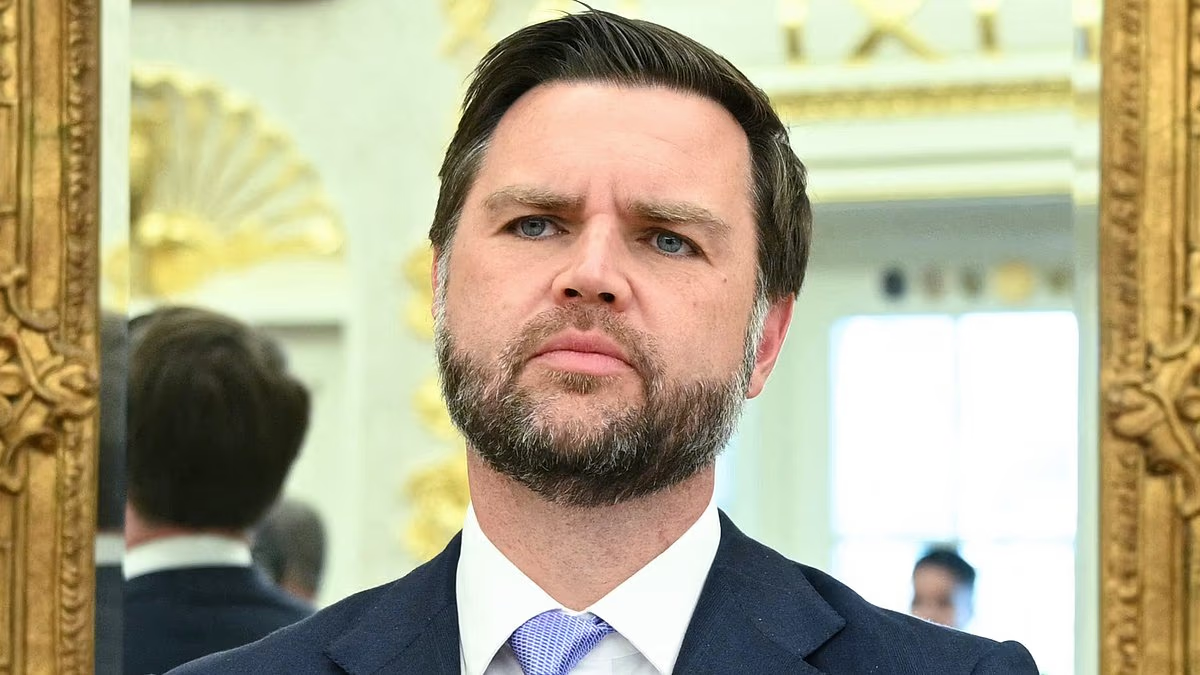

JD Vance is attempting one of the most precarious balancing acts in modern American politics.
The vice president suffered a crushing setback on Tuesday night after voters rejected Donald Trump’s version of conservatism and handed Democrats control of both the House and the Senate.
Vance’s chances of winning the White House in 2028 plunged on prediction markets. The former favorite now trails newly re-elected Georgia Senator Jon Ossoff.
The vice president moved quickly to blame the Iran war in a lengthy statement published on X early Wednesday. Trump began the conflict in February despite Vance’s private reservations, and the carefully worded post placed much of the blame for the midterm defeat at the president’s door.
Donald Trump Jr, who has privately voiced his own objections to the war, joined the criticism less than an hour later. “Every word of this is [100 emoji],” he wrote.
Confronted with Vance’s remarks at the White House several hours later, Trump largely accepted the vice president’s analysis but refused to say the war had been a mistake.
“I think it’s largely true because it drove the gasoline up … but at the same time if I had it to do again, I’d have to do it again,” he said.
A close reading of Vance’s election post-mortem exposes the high-risk strategy he is pursuing as blame spreads through a White House led by an isolated, lame-duck president known for abandoning allies at the first hint of disloyalty.
One of the things the data analysts on our side obsessed over was “composition”—whether the electorate looked close enough to 2024 for Republicans to win. And despite polls that showed a Democrat blowout, the data kept on telling us the same story: in some states turnout was…
— JD Vance (@JDVance) November 4, 2026

JD Vance listens to President Trump during a meeting with Stephen Hubbard in the Oval Office on October 30

Trump speaks at the White House on Wednesday as the final steel beam is installed in the ballroom
What JD Vance’s statement reveals
What Vance says: One of the things the data analysts on our side obsessed over was ‘composition’ – whether the electorate looked close enough to 2024 for Republicans to win. And despite polls that showed a Democrat blowout, the data kept on telling us the same story: in some states turnout was merely OK, in other states it was downright amazing, and in no state was it catastrophic. There was a genuine sense of optimism on our team: our people were showing up.
What he means: Vance begins by conceding that the Republican political operation misjudged the anger among ordinary voters, including in the deep-red states that backed Trump in all three of his White House campaigns.
Susie Wiles, now the White House chief of staff, and her ally Chris LaCivita ran that operation with considerable success in 2024.
Sources told Our News Outlet that Wiles repeatedly assured Trump he would win the midterms, even as his approval rating fell to 32 percent. Vance is suggesting that the “genuine sense of optimism” came from her team.
What Vance says: So, I asked the smartest data guy I know, does that mean we’re going to shock the world? ‘No,’ he told me. ‘We might do better than the polls suggest. But the data is telling us that a lot of Trump/Vance 2024 voters are pissed and planning to vote for the other guys. Our voters are turning out, but they may not vote for us.’
That warning now looks prophetic. Republican voters did turn out. In Florida, for example, the electorate was nine points more Republican than Democratic, only a few points worse than in 2024. Turnout could certainly have been stronger in some areas, but the central problem was not participation. It was that many people who voted for Trump and Vance in 2024 backed Democrats in 2026.
What he means: Vance repeatedly attaches his own name to the 2024 coalition, invoking “Trump/Vance” twice while avoiding a direct accounting of his own record in government.
At the same time, he acknowledges that some Republican operatives recognized the danger and that their warnings were ignored.
Yet when those same voters appear in the next section as angry defectors, Vance refers to them only as “Trump 2024 voters.”
What Vance says: There will be a lot of infighting and arguing over what happened and why that is. One of the pollsters I really respect told me that our economic messaging wasn’t sharp enough down the stretch. I’m sure that’s true.
But the real reason we lost is obvious to almost everyone.
What he means: Vance is preparing his defenses as the accusations begin. By predicting “a lot of infighting and arguing,” he positions himself above the internal Republican struggle just as leaks start pouring out of the White House.
He avoids saying that the economy itself is failing, instead arguing that the administration’s economic message was inadequate.
What Vance says: Another pollster – one of the smartest people I know in politics, told me yesterday we’d lose the generic ballot by 13 points. I felt negative going into Tuesday, but even I was shocked by this. In his polling, he saw that a lot of Trump 2024 voters were angry and planning to vote for Democrats. He asked those voters who had abandoned us what would cause them to come back on our team. The top four answers, accounting for nearly all of the responses were:
1) End the war
2) Focus on cost of living/inflation
3) Put America First
4) Change our relationship to Israel
What he means: Those four points amount to a preliminary 2028 platform for Vance: a measured shift away from Trump’s definition of MAGA and toward a more explicitly America First agenda.
Each item challenges a core aspect of the administration Vance currently serves, although every recommendation is attributed to the conveniently unnamed pollster.
FIND OUT MORE: Chris Pratt Recalls Living in a Van Before Hollywood Fame
The list also conspicuously omits concerns about apparent government corruption, which national exit polling indicates may have been the most important issue for voters.
Vance also leaves out his own prominent role in efforts to end the conflict. He led peace talks with Iran in Islamabad in April.
Trump joked at the time: “So, if it doesn’t happen, I’m blaming JD Vance.”
Seven months later, Vance is arguing that the war, rather than the failure of those negotiations, cost Republicans control of Congress.
What Vance says: Our voters showed up. And the above four reasons are why many of them voted for Democrats. This is according to a pollster who nailed the results. While many spent Monday attacking Rachel Campos Duffy for calling for a diplomatic resolution to the conflict, it turns out her political advice was sound. (She’s also a great person.)
What he means: Vance is making a direct criticism of the administration’s record, insisting that Trump supporters did not merely stay home but participated and chose Democratic candidates.
Early exit polls support that interpretation, although stronger Democratic turnout also appears to have contributed to the result.
Vance’s reference to Rachel Campos Duffy, the Fox News host and wife of Transportation Secretary Sean Duffy, is deliberate.
She has faced accusations of antisemitism over her opposition to the Iran war and has responded to conservatives who accused her of moving to “the dark side.”
Vance again highlights his differences with Trump over Israel and the war. By calling Campos Duffy “a great person,” he makes the defense personal while echoing the allegations directed at him over his own anti-war stance.
What Vance says: In the next few months, there’s going to be a lot of gaslighting. Expect to hear any number of establishment politicians say the solution to our woes is amnesty. I’m open to the idea that we should change enforcement – by focusing more on businesses that hire illegal labor, for instance. But anyone pushing amnesty is lying to you.
What he means: Vance’s reference to “gaslighting” is directed at the “establishment politicians” he expects to promote amnesty as the answer to the party’s problems.
By labeling those future critics part of the establishment, Vance seeks to protect himself from Republicans who may advocate a more moderate immigration policy.
He nevertheless hints at a less sweeping approach to enforcement. His proposal to focus more heavily on businesses that employ undocumented workers suggests a tacit acknowledgment that ICE raids may have gone too far, while affirming that he remains committed to enforcement.
What Vance says: The reason we lost is the war. The president himself said so last night.
What he means: This is the most forceful line in the statement and a calculated piece of political maneuvering. By claiming that Trump agrees with him, Vance narrows his apparent distance from the president even as he draws a sharper policy distinction.
Trump said on election night that “Iran was a piece of it,” but he did not identify the war as the main cause of the Republican defeat.
He told Fox News: “I don’t think it’s the war… I think it’s the gasoline price.” He offered another explanation to the Wall Street Journal: “The biggest issue is that I wasn’t on the ballot.”
Vance recasts his considerably tougher assessment as a position shared by Trump, rather than presenting it as a challenge to the president.
What Vance says: If you’d like to argue it was worth it, that losing the Senate for the next 6 years was worth it, then do so. Argue it was a worthwhile cost to pay. Agree or disagree, that’s at least honest.
But everyone knows why we lost. And any honest conversation about where we go from here must start there.
What he means: Vance challenges his critics to defend the war’s cost, and Trump responded to that challenge only hours later.
Asked whether the war had been worth it, Trump replied: “I do, yeah … I would have done nothing differently.”
Trump said he had understood Vance’s position from the beginning. “I know how he feels about it,” he said, while describing the vice president’s statement as “good.”
But Trump offered a notably cooler assessment of Vance’s political future. “Maybe he won’t run, I don’t know who’s gonna run,” Trump told reporters.
What Vance says: I remain hopeful about our country. To the people who are pissed off and want to say, ‘I told you so’: you’re right, you did tell us so. Take that energy into electing Republicans who share your worldview. To the people who are just pissed at the results, you should be. Let’s take that anger and get back to the work of saving our country.
What he means: This is Vance’s attempt to connect with disillusioned voters, acknowledging that he has heard their message as he approaches a decision about a 2028 campaign.
He offers an unusually direct concession to the administration’s critics: “you’re right, you did tell us so.”
The implication is that the current administration failed to listen, while the next Republican president would take those warnings seriously.
Vance is urging voters not to leave the Republican Party, but to channel their anger into a debate over its future.
His political prospects are now closely linked to whether Trump absorbs those lessons during his final two years or rejects them. Either way, the strain between the president and his potential successor has become harder to ignore.