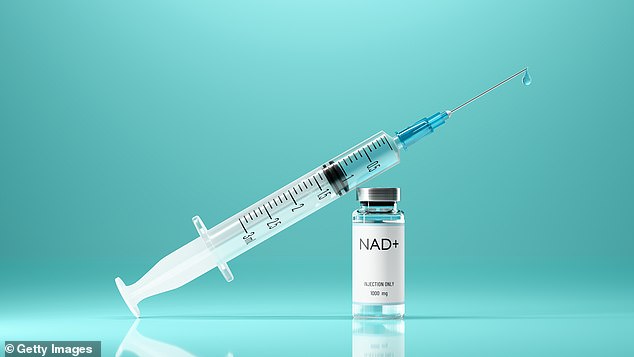

Getting hooked up to a NAD+ drip or taking it as a supplement has become one of the most fashionable anti-ageing trends in wellness.
Hailey Bieber was filmed receiving an NAD drip on an episode of The Kardashians, joking: ‘I’m going to NAD for the rest of my life, and I’m never going to age.’
Gwyneth Paltrow has spoken publicly about her enthusiasm for IV wellness treatments, while Jennifer Aniston has been reported to use NAD+ IV drips, helping fuel the treatment’s celebrity cachet.
Now NAD+ has become one of the hottest buzzwords in wellness, sold in forms ranging from IV drips and at-home injection kits to pills, powders and stick-on patches.
Clinics and supplement brands claim it can boost energy, sharpen the brain, strengthen immunity and even help slow ageing.
But experts are divided. Some warn the booming market has raced ahead of the science, with products that may be useless, poorly regulated or potentially risky. Others insist they have seen real improvements in patients, particularly those suffering from fatigue, brain fog and poor sleep.
NAD+, short for nicotinamide adenine dinucleotide, is a molecule found in every living cell. It plays a crucial role in helping the body convert food into energy and is also involved in DNA repair and other vital cellular processes.
Dr Michael Sagner, a clinical adviser at King’s College London who specialises in longevity and preventative medicine, told the Daily Mail: ‘It’s an essential component of how a living cell produces energy – obviously without energy it would die. And as we age, it has been shown that NAD levels decline.’

NAD+ has become a lucrative longevity trend – but does the science match the claims?
That age-related fall has helped turn NAD+ into a lucrative longevity trend. Supporters claim topping up levels may help tackle tiredness, brain fog and signs of ageing by improving how cells function and repair themselves.
Dr Sagner said: ‘The assumption was that if we stop this decline, or if we somehow managed to increase energy levels, that we could slow down ageing.’
A booming market has followed. NAD+ IV drips can cost hundreds of pounds a session, with some clinics charging up to around £400 for an hour-long treatment and more for longer courses. At-home injection kits can cost about £350 for a month-long course, while pills, powders and patches are sold for anything from £20 to £80 or more.
Market estimates vary widely, depending on whether analysts are counting NAD+, NAD precursors, supplements, skincare or wider longevity products. But the broader NAD+ and NAD-precursor sector is now valued from the hundreds of millions into the billions, with forecasts predicting sharp growth over the coming years.
While the marketing has become increasingly glamorous, Dr Sagner argues the evidence in healthy humans remains limited and any claims that NAD+ products can extend life or reverse ageing are largely unproven and are based mainly on animal studies.
‘It’s extremely difficult to do these trials because you’d have to have thousands of patients, and make sure they take it every day,’ he said. ‘And what will we actually measure?
‘In animal models where you have a life expectancy of a year, two years, three years, it’s a lot easier to measure these things. In humans it’s basically impossible. It hasn’t been done for any substance that increases NAD levels.’
He said there are some ‘promising’ disease-specific studies, including in Parkinson’s and cardiovascular disease, but added that this is very different from proving that NAD+ can keep healthy people young.

Dr Enayat claims his patients have seen positive results after taking NAD+
‘It’s very difficult to measure ageing,’ he said. ‘It’s more about being disease-free for as long as possible as you get older.’
His biggest concern is the popularity of NAD+ IV drips, which deliver the compound directly into the bloodstream.
Dr Sagner described parts of the NAD+ drip industry as ‘murky’ and a ‘very grey market’.
He said: ‘A lot of stuff that happens in these underground drip clinics in London and elsewhere are very hush-hush.
‘Some of them have apparently removed the NAD+, and just tell the patients it’s NAD+ and charge them for it. They infuse a little bit of vitamin C or something else because they are afraid of the side effects, but they still want to make money.’
He added: ‘You can’t really take NAD+, or you shouldn’t, especially intravenously. Those drip clinics that offer it are very dangerous.
Do you want to lose a stone in six weeks?

Hi, I’m Emma Bardwell, a nutritionist with more than 15 years’ experience helping people improve their health and lose weight.
I’ve been there. I was overweight, unhappy with my skin and stuck in a rut. Then I changed the way I eat. You can now do the same with my tried-and-tested healthy eating plan. And for DailyMail+ subscribers, it’s completely free.
Click here to sign up and start your journey
‘We have seen a lot of adverse side effects such as inflammation, allergic reactions, and so on.
‘After the drip, people can have headaches and dizziness.’
Dr Sagner said he had heard reports of serious complications following NAD+ infusions, although such cases can be difficult to verify publicly.
He also questioned whether many of the products being sold actually increase NAD+ in a meaningful way. According to him, the body is designed to make NAD+ inside cells from precursor compounds, rather than receive NAD+ directly through the bloodstream.
He said: ‘Your body doesn’t want it in the bloodstream. The only thing that makes sense is taking NR orally, if someone wanted to increase their NAD+ levels.
‘It’s a small molecule, but it does not enter the cell. Which means your body has to break it down, which partly explains why people who take any of it intravenously by a drip get this inflammatory response, because you should not have a high amount of NAD, or probably any NAD, in your bloodstream. It belongs in the cell.
‘Your body uses precursors, little components, building blocks, and then makes it inside the cell.’
The two best-known NAD+ precursors are NR, or nicotinamide riboside, and NMN, or nicotinamide mononucleotide. These are sold as supplements and are designed to give the body the raw materials to make NAD+ itself.
Dr Sagner said that, if someone is determined to try to raise their NAD+ levels, oral NR is the most sensible option.
‘NR is the gold standard if someone wants to increase their NAD levels,’ he said.
However, he warned consumers to be careful about where they buy supplements from because quality and regulation vary widely.
In the UK, NAD+ supplements sold without medicinal claims are generally regulated as food supplements rather than medicines, meaning they are not assessed by the MHRA for efficacy in the same way as licensed drugs.
Dr Sagner said some products are made by suppliers that adhere to recognised quality standards, but added that many IV drips, powders, patches and at-home kits are not properly tested.
‘You never know where that’s actually coming from,’ he said.
He was particularly sceptical of NAD+ patches, saying they ‘make no sense’.
There is also a more controversial concern: whether artificially boosting NAD+ could have unintended consequences.
Dr Sagner said: ‘We don’t want to boost NAD levels endlessly. There is the risk of increasing your cancer risk.’
NAD+ supplements have not been proven to cause cancer in humans. But some scientists have raised theoretical concerns because NAD+ is involved in cellular energy production and DNA repair, processes that are also important in cancer cell survival and growth.
There may also be another downside to trying to make cells more metabolically active. Dr Sagner said that boosting the pathways involved in energy production could also increase the amount of biological ‘waste’ produced by cells.
‘Whenever you boost something or increase something that actually increases possible energy production, you also increase the amount of waste product,’ he said.
In other words, the concern is that driving cells to produce more energy may also create more by-products that the body has to process and clear.
Dr Sagner added that many long-lived animals tend to have slower metabolisms rather than faster ones.
‘And we know that animals that live a very long life actually have a very slow metabolism. Turtles, elephants, and so on.’
The point, he said, is that ageing biology is more complicated than simply trying to make cells run faster.
But not all doctors are so sceptical about NAD+.
Dr Enayat, a GP and founder of the longevity clinic HUM2N, argues that it can be beneficial for some patients and says he has seen improvements in symptoms such as brain fog, low energy and poor sleep.
And in his opinion, whether NAD+ enters the cell directly or is simply introduced to the blood is less important to him than the clinical improvements he sees in practice.
‘I’m not a scientist, I’m a doctor,’ he said. ‘I see my patients improve, clinically – and that’s where I build my confidence with them. Whether the NAD+ is extracellular or intracellular to me, is by the by.’
He added: ‘In theory, scientists say it has to be intracellular to provide any noticeable benefit, but I would argue and say that if that’s the case then why do my patients feel better energetically? How do they report better motivation?’
Dr Enayat said around 75 per cent of his patients report symptom improvements, including better energy, sleep and mental clarity.
However, he also warned that NAD+ is being oversold.
He said: ‘There is a lot of misselling of NAD+, with people upselling that this is going to be some kind of transformation for anyone and everything at the same time. And I don’t believe it’s that, I think you need it when you’re depleted.’
That view is not entirely at odds with Dr Sagner’s more cautious advice. He said the most sensible approach is not to chase NAD+ blindly, but to check whether levels are actually low.
‘A smart idea would just be to measure it,’ he said. ‘If you think you have low NAD levels, there are labs, they can measure it.
‘And if your levels are low, why not just take NR for a while, measure again, treat it like a deficiency instead of injecting yourself, or taking something randomly.’
He said oral supplements may be able to raise NAD+ levels within one or two weeks, adding: ‘If you’re forty plus, maybe just get some high-quality NR and take it for three weeks and see how you feel – if it improves energy levels.’
But he stressed there is still no proof that doing so will deliver long-term anti-ageing benefits.
When contacted for comment regarding NAD+ supplements, a representative for the MHRA said: ‘In the absence of medicinal claims, NAD+ supplements are not medicinal products and they do not fall under the remit of MHRA; we cannot advise on their efficacy or safety.’
For now, experts say anyone considering NAD+ injections or IV drips should be cautious, particularly if they have existing health problems, are taking medication or have a history of cancer.
And while the celebrity wellness world may be selling NAD+ as the latest shortcut to youth, the more measured advice from both sides is less glamorous: avoid overblown claims, be wary of unregulated providers and do not assume that more is always better.