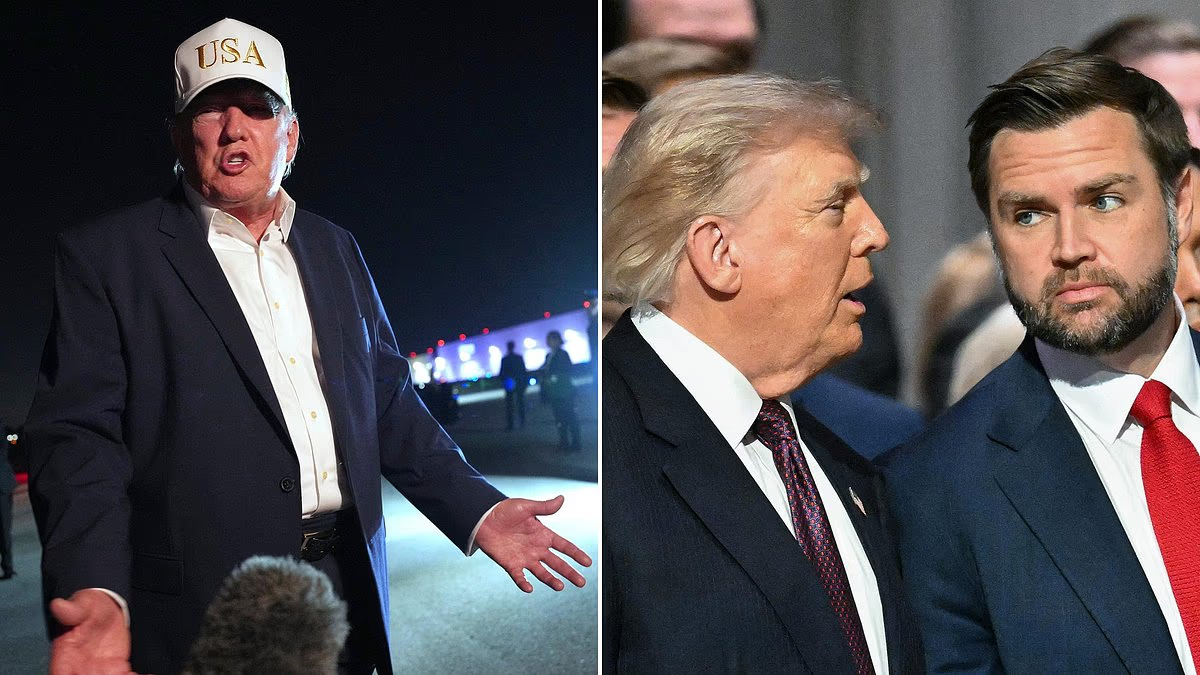

President Donald Trump says many Republicans reacted negatively to JD Vance’s criticism of the Iran war, while challenging his vice president to answer one question after the party suffered a devastating defeat in the midterm elections.
Trump rejected suggestions that the dispute had weakened his relationship with Vance, even after the vice president publicly attributed the GOP’s poor performance to the eight-month conflict.
Speaking to reporters before boarding Air Force One in Florida on Sunday night, Trump said Vance had overlooked what he considered the central issue: whether he would make the same decision to go to war with Iran if he were given another opportunity.
Asked whether Vance’s criticism of the administration’s policy had created tension between them, Trump gave an unequivocal response.
“No, not at all,” the president said. “But a lot of people didn’t like his comments, but not me.”
Trump said Vance’s analysis was largely correct, but argued that the vice president should have addressed whether the military campaign had been worth the political cost.
“If you had to do it again, would you do it again? The answer is yes,” Trump said.
He insisted that history would regard the decision as one of the administration’s most important actions, arguing that Iran could have threatened global security if it had acquired a nuclear weapon.

President Donald Trump said Sunday night that many people disliked JD Vance’s remarks blaming the Iran war for the Republicans’ midterm election defeat

Trump said his relationship with Vice President JD Vance remained solid despite their differing views on the controversial Iran conflict. The two are pictured together in July

The Iran war has become a serious political challenge for the Trump administration, with Vance linking the conflict to the GOP’s heavy election losses. Smoke and flames rise after airstrikes hit an oil depot in Tehran in March
Trump made the remarks only hours after discussing the same dispute during an extensive interview on CBS’s 60 Minutes, where he conceded that Vance’s explanation for the Republican defeat might have merit.
Throughout the interview, however, Trump appeared eager to dismiss claims that the disagreement had caused a serious rift.
When correspondent Ross Douthat asked whether he agreed with Vance’s assessment of the election, including the vice president’s criticism of America’s ties with Israel, Trump replied that he did not disagree.
Trump then returned to the point he believed Vance had left unresolved: whether the vice president would approve the decision to attack Iran if he had to make it again.
Trump said that was the one statement he wished Vance had made, adding that the vice president had been involved in the decision-making process.
The president said his own answer was an emphatic yes because, in his view, Iran could not be allowed to develop a nuclear weapon.
Trump acknowledged that the operation might not deliver an immediate political benefit, but maintained that its long-term significance would justify the choice.
“Is it a good decision for today and tomorrow? Maybe not,” he said, adding that he had to do what he believed was right for the country.
DISCOVER MORE: Chloë Sevigny Reveals Her Best Supporting Actress Oscar Pick

During his 60 Minutes interview Sunday, Trump said he did not reject Vance’s election analysis but predicted history would ultimately support the decision to strike Iran

Vance said former Trump voters had moved away from the Republican Party over the Iran conflict, rising prices and the US relationship with Israel. He is pictured in Texas last month
Trump argued that failing to prevent Iran from obtaining a nuclear weapon would have carried much more serious consequences.
Vance, viewed by many Republicans as a possible 2028 presidential candidate, shocked party observers on Wednesday by directly blaming the war for the GOP’s loss of both chambers of Congress.
In a lengthy post on X, Vance said the conflict was the reason Republicans had lost, pointing to Trump’s own comments the previous night.
The vice president referred to polling that suggested voters who had supported Trump in 2024 were turning against Republicans because of the war, the pressure of inflation and Washington’s approach to Israel.
Vance said a pollster had identified four major concerns among disenchanted Trump supporters: ending the conflict, lowering inflation, pursuing an America First agenda and reshaping the US relationship with Israel.
He argued that those issues explained why many former Republican voters had backed Democrats in the election.
Vance also challenged supporters of the war to acknowledge the damage it had done to the party politically, rather than defending the campaign without addressing its consequences.
He suggested that anyone who believed the operation was justified should openly argue that losing control of the Senate for six years was an acceptable price.

President Donald Trump speaks to reporters before boarding Air Force One in West Palm Beach, Florida, on Sunday evening

Trump pressed Vance to say whether he would authorize the Iran war again, making clear that he would repeat the decision
Join the discussion
Was launching the Iran war worth the political fallout and public backlash faced by Republicans?
The unusually blunt intervention prompted speculation that Vance was trying to separate himself from Trump’s increasingly unpopular foreign policy as he considers a potential White House campaign.
Iran has consistently said its nuclear program is peaceful, although international inspectors have expressed concerns about the country’s stockpile of highly enriched uranium.
Efforts to restore diplomacy have so far failed to produce a durable end to the conflict.
Trump has also said US forces have identified dozens of Iranian infrastructure sites, including 38 bridges, that could be targeted if large-scale fighting resumes.
Despite attempts to restart negotiations, American forces have continued limited operations, including attacks on Iranian air-defense systems.