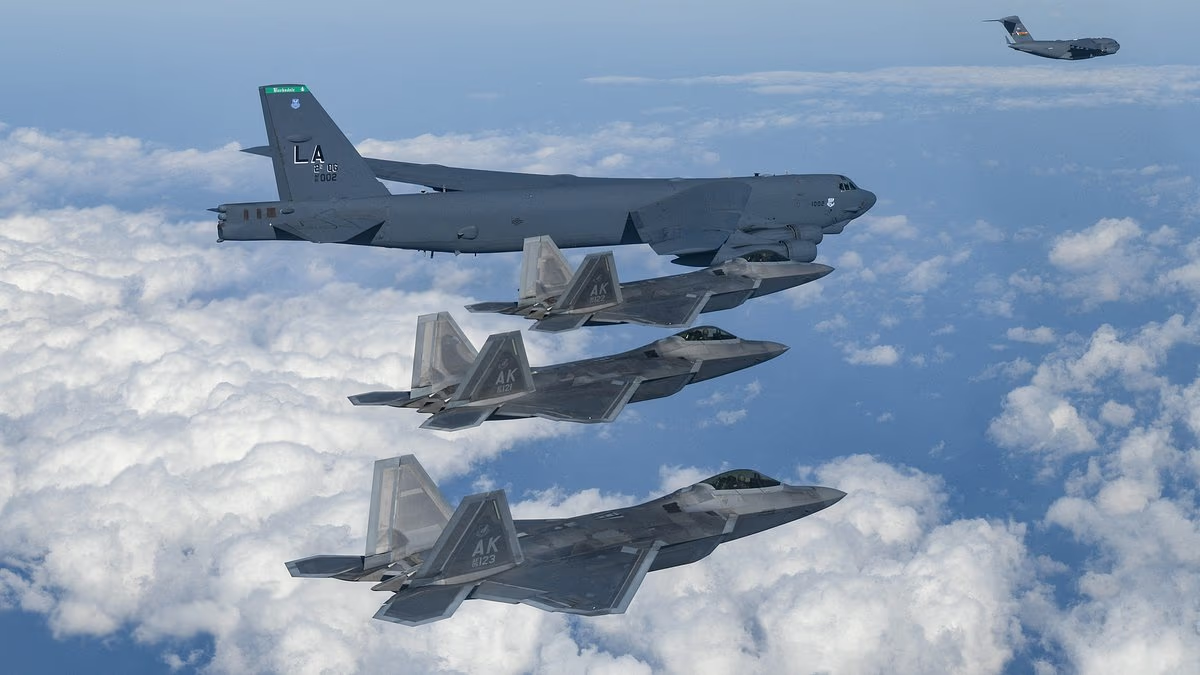

The United States is testing its ability to control and communicate with its nuclear forces during a crisis as a major military exercise gets underway.
US Strategic Command confirmed Tuesday that its annual Global Thunder 27 exercise has begun, cautioning that the public may notice increased activity from bombers and support aircraft in the skies.
The exercise recreates complex crisis scenarios designed to evaluate military decision-making, communications systems and the ability to respond to a potential attack.
Its broader goal is to ensure America’s nuclear forces remain ready, secure and capable of operating effectively while reinforcing the country’s deterrence strategy.
Flight-tracking data showed B-52 bombers leaving Minot Air Force Base in North Dakota, while several E-6B Mercury aircraft were observed operating over the United States in recent hours.
Often called ‘doomsday planes,’ the E-6Bs function as airborne command and communications hubs, helping keep national leaders connected with the nation’s nuclear forces.
Aviation notices also identified temporary airspace restrictions over portions of the Atlantic, Pacific and Florida that may be associated with Global Thunder. One notice directly named the nuclear exercise.
Military officials emphasized that Global Thunder is a regularly scheduled annual drill, not a response to a specific country or unfolding international event.

The US military has begun a nuclear readiness exercise focused on keeping America’s nuclear forces prepared, secure and capable of deterring an attack (stock)

Temporary airspace restrictions over the Atlantic, Pacific and Florida may be connected to Global Thunder, with one notice explicitly identifying the nuclear exercise
Global Thunder 27 began on October 22 and is expected to continue for approximately 10 days.
While the exercise has been running for several days, reports of military aircraft over the United States began emerging only within the past 24 hours.
At least five E-6B aircraft were spotted Tuesday afternoon. Another was reported Wednesday morning after departing Oklahoma and heading northwest.
Tracking data also indicated that B-52 bombers were flying north from the Minot region into Canada, while other aircraft traced looping paths over Louisiana and Mississippi.
A B-1B Lancer bomber was separately tracked over western Texas.
The US nuclear arsenal is organized around three components, collectively known as the nuclear triad: land-based missiles, ballistic missile submarines and long-range bombers.
IN CASE YOU MISSED IT: Hearing Knocks at Night? Audiologist Reveals 5 Spooky Signs of Early Hearing Loss
The land-based leg consists of Minuteman III intercontinental ballistic missiles stored in reinforced underground silos.
At sea, submarines are equipped with nuclear-armed Trident II missiles, while B-52 and B-2 bombers form the airborne element of the triad.

At least five E-6B ‘doomsday planes’ were observed Tuesday afternoon, followed by another reported the next morning (stock)
Together, the three legs provide national leaders with multiple options for responding to an attack and help preserve the ability to retaliate if one part of the force is destroyed or disabled.
The E-6B is based on Boeing’s commercial 707 airliner and has been extensively modified with communications equipment that allows it to maintain links between national leaders and nuclear forces.
Among its systems are long trailing-wire antennas used for very-low-frequency communications with ballistic missile submarines.
The aircraft is also equipped with an airborne launch control system capable of supporting the launch of America’s land-based intercontinental ballistic missiles.

Tracking data showed B-52 bombers traveling north from the Minot area into Canada, while other aircraft flew looping routes over Louisiana and Mississippi

The E-6B, derived from Boeing’s 707, carries specialized systems for maintaining communications between national leaders and nuclear forces
The B-1B Lancer, by contrast, is now used solely for conventional missions. The Air Force ended its nuclear role in 1994 and completed the bomber’s transition to conventional-only operations in 2011.
Although flight maps reveal where aircraft traveled, they do not show what weapons they may have carried or prove that every aircraft displayed was involved in Global Thunder.
Several aviation notices established temporary blocks of restricted airspace, designating specific portions of the sky for set periods so air traffic controllers can separate military activity from other flights.
The strongest connection to the nuclear drill appears in an Atlantic airspace reservation titled ‘Global Thunder (Oak Bravo),’ which extended from the ocean surface to about 25,000 feet.
That restriction was scheduled to remain in effect from 10am Eastern on Tuesday, October 27, through 11pm Friday, October 30.
Additional notices reserved airspace over the Atlantic, Pacific and Florida, including one that instructed pilots to use ‘extreme caution.’
Separate notices extended operating hours at Minot Air Force Base and restricted Whiteman Air Force Base to official business. None directly stated that those measures were part of Global Thunder.